
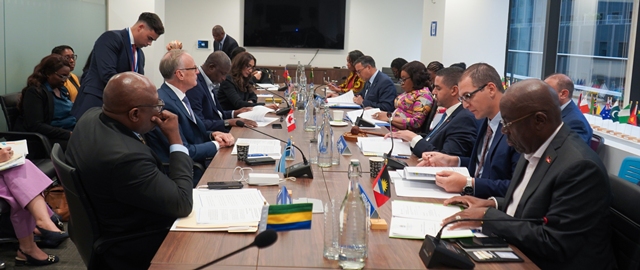
 September 2025: CMAG meeting. [photo: Commonwealth Secretariat on Flikr]
[This is an excerpt from an article in The Round Table: The Commonwealth Journal of International Affairs and Policy Studies.]
Overall, Ministers seem to have preferred this a conservative approach to CMAG’s ‘enhanced mandate’, leaving most of the running and leadership to the Secretary-General and her staff on specific issues. This has led some to accuse CMAG of withering on the vine and being a pale shadow of its former self, not least from Commonwealth civil society. There is some truth in this. Civil society may prefer a more robust approach, but their voices are seldom heard in CMAG itself, and they could do more to lobby CMAG Ministers more actively on issues of concern.
But the potential for wider action is still there if the new Secretary-General wants to take the opportunity to do so. Her announcement to Foreign Ministers in New York in September 2025 of a ‘Democracy Fragility Index’, designed to track risks to democratic stability and through new partnerships provide early warning to help avert crises, is a worthy initiative. But how it relates to her good offices and engagement with CMAG is yet unknown and will be an important test.Footnote18.
Indeed, at its last meeting in September this year, CMAG Ministers specifically:
Reflected with concern on the growing pressures to democracy, the rule of law, judicial independence, human rights, and democratic space faced by all countries, including those within our Commonwealth family. The Group encouraged members to support the Good Offices of the Secretary-General and the work of the Secretariat to accompany the members of our Commonwealth family as they work to entrench the values of the Commonwealth in their nations.Footnote19.
Given the current turbulence in domestic and international relations when democracy itself and human rights more broadly are increasingly under assault, including in Western nations with the rise of populist governments, CMAG and its Ministers certainly have the scope under the Millbrook Programme of Action and the Perth mandate to play a more active role in addressing a wide range of issues relating to Commonwealth values.
From the archives: The right to speak freely
A place to stand: the problems and potential of the Commonwealth ministerial action group
Ten years on: Focus on the Commonwealth Charter
The shaping of the modern Commonwealth Secretariat – through the eyes of its former SG’s
But it is a clunky mechanism, as anyone seeking to convene nine busy Foreign Ministers from across the globe can testify. The success of the Secretary-General’s much more flexible, discreet, and immediate good offices efforts has also meant that many member governments would prefer these to be utilised instead. But are they always good enough and could a more active role by CMAG enhance them?
It is also probably time for a new High-Level Group to be established to work with the Secretary-General and CMAG Ministers on a fresh look at how to advance these matters. After all, it is now nearly 15 years since the Eminent Persons Group reported to the 2011 Perth CHOGM. One might hope leaders at next year’s CHOGM in Antigua and Barbuda might support the establishment of such a group, with it to report at the following CHOGM.
On good offices, Ministers could be more directly involved as they were in the early days of CMAG and in the case of the Maldives, including by visiting countries of interest. Peer group pressure of fellow political leaders could be a significant additional pressure to strengthen the Secretary-General’s engagement. There are urgent situations and questionable constitutional and electoral processes at present which fall short of Commonwealth values and processes – such as in Tanzania, Cameroon and Guyana – which require immediate attention and where CMAG Ministerial engagement could help.
Furthermore, election Observer Group reports and democracy activities could be automatically reported to CMAG and in greater detail. This might help avoid some of the recent controversies surrounding the publication of COG reports, such as about Zimbabwe in 2023 Footnote20 and Pakistan in 2024.Footnote21 These reports were felt to be inordinately delayed and led to lack of confidence in their management. The speedy publication of the Gabon COG Report this year was a positive development. As all Observers know, these reports are in fact finalised within a week or so, before they leave the country.
In addition, Ministers might be encouraged to raise issues of concern from their own regions and provide more in-depth briefings to other Members on background issues and how best to target democratic assistance in an exercise of preventive diplomacy. Broader human rights issues might be discussed as a matter of course.
Civil society and other Commonwealth groups such as the CHRI, the Commonwealth Lawyers Association (CLA) and the Commonwealth Magistrates and Judges Association (CMJA) could be actively encouraged to provide more briefings and even on occasion to meet with Ministers.
In truth, the issue is not so much one of the mandate for CMAG, but rather how to look more imaginatively at how it might engage with the Secretary-General to take full advantage of the mandate it has had since the Perth CHOGM. With a new Secretary-General having just taken office, it is the ideal time to have just that sort of discussion.
Managed well, it could only enhance the Commonwealth’s role as a guardian of democratic values and human rights at a time when these are under threat as never before in our century.
Matthew Neuhaus is the Hon Professor, ANU College of Law, President of the Australian Royal Commonwealth Society, a former Australian High Commissioner to Nigeria and a member of the Round Table’s international advisory board.