
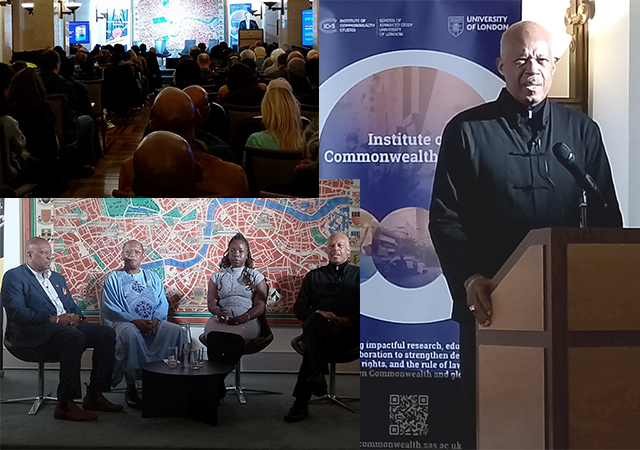
 [clockwise] Senate Hall audience, Sir Hilary Beckles, panel: Arley Gill, Eric Phillip, Niambi Hall Campbell and Hilary Beckles. [photos by Debbie Ransome]
For many people, the issue of slavery reparations is a recent headline-grabber. But for the Caribbean Reparations Commission (CRC), it’s the latest stage in a movement that has been two to three centuries in the making.
And as Prof Sir Hilary Beckles, who chairs the Caribbean Community-appointed CRC, pointed out in a London lecture on 17 November, the issue of slavery reparations “is not going to go away”.
Prof Beckles, a UK-trained historian who is also Vice-Chancellor of the University of the West Indies (UWI), put the debate in its historical perspective at the event, entitled The Coming Enlightenment: Reparations Now for Tomorrow, organised by the Institute of Commonwealth Studies (ICwS) and held at the University of London’s Senate House.
His fellow CRC panel members were Arley Gill, Chairman of the Grenada National Reparations Committee; Eric Phillip, Chairman of the Guyana Reparations Committee; and Dr Niambi Hall Campbell-Dean, Chairperson of the Bahamas National Reparations Committee.
Putting their work in the context of an “historical conversation”, the CRC team said that they had no intention of adding to the anger on the reparations issue and instead wanted to “build a better world for all of us”.
Prof Beckles outlined to the packed hall the reparatory justice argument – the “philosophical concept” of the need for justice wherever there are crimes. He said that the current debate was phase three of a continuing discussion about transatlantic slavery.
Phase one, in the 1800s, was the original debate over abolition and emancipation, when Britain argued over the moral and economic questions raised by enslaving people. Prof Beckles outlined his study of the papers of abolitionist William Wilberforce at Hull University.
Phase two came with the independence movements that led to the end of the British Empire and the formation of new nations which at the time, unsuccessfully, sought British help to rebuild from plantation colonies.
Sorry is not the hardest word – reparations is
Book review – Britain’s Black Debt: Reparations for Caribbean Slavery and Native Genocide
Research Article – An African Union-Caribbean Community alliance in the global reparations movement: promises, perils, and pitfalls
Prof Beckles argued that phase three of the “conversation” had been going on over the last few years. The arguments include calls for a “summit for mutual development” based on reparatory justice. This would involve developing a strategy to address the infrastructural, educational, financial and other needs of the former enslaved in their countries. Others, however, are calling for more immediate action in the form of reparations.
The commission pointed out that the UK’s industrial development and modern state had been built on the legacy of slavery, meaning that people could not say it was in the past and they had played no direct role. “All of us are in this together,” Prof Beckles said, urging people not to distance themselves or bury their heads in the sand when faced with the discussion over slavery.
Not after hard cash
The CRC places itself in the middle ground of the discussions. The commission, appointed by Caribbean Community (CARICOM) heads of government to draw up a strategy for engagement on reparations, has issued several versions of its 10-point action plan, mandated to chart “the path to reconciliation, truth, and justice for the victims of slavery and their descendants”. That plan is undergoing another revision as discussions continue.
The commission wants to “defuse the conflict”, as Prof Beckles describes it, and move to a “partnership” on developing agriculture, education, technology transfer and revisiting debt infrastructures. Members pointed out that many newly independent countries had to borrow to build their new nations, starting on the debit side of history. They also mentioned the Colombo Plan, which had helped build up Asia-Pacific countries after independence.
Mr Gill told the audience that the team had not arrived with containers at a British port ready to collect British taxpayers’ money for reparations. Members described themselves as “up against a headwind” in parts of the British press, accused of trying to break the UK Treasury. Mr Gill said that the commission was not after “hard cash” but “an engagement, a discussion” to look at the long-term harm caused by slavery in various countries’ infrastructure and debt.
Keen to defuse the “anger and rage” they had faced at the start of their work, the CRC representatives carefully outlined their aim to talk about a strategy with the UK for reparatory justice in a “mutually beneficial way” – with actual reparations (action) coming later.
Chattel society
Barbados is at the hub of their argument. As the place where slavery was first “codified” in the form of the 1661 Act for the better ordering and governing of negroes, the island has grown from a system where the law allowed people to become property to the modern society it is today, but still with its “chattel society” infrastructure and chattel houses.
Prof Beckles put this in its historical context: as Spain and Portugal struggled to maintain the profitable slave industry in line with Catholic Church principles, Britain codified slavery and made it a straight economic transaction.
Describing sugar production as the newest “entrepreneurial opportunity” and the ”latest bonanza” of the time, Prof Beckles pointed out how the industry and the resources needed to make it work became “irresistible” to people who had money. The classifying of enslaved people as assets allowed Britain to have “total control” over the process.
Reparations for Slavery Becomes A Commonwealth Issue
Has the Commonwealth a Role to Play in the Row over Reparations for the Slave Trade?
He outlined the numbers behind the Caribbean slave trade. He said records indicated that more than three million Africans were taken to the Caribbean under slavery. By emancipation, there were 83,000 slaves – 20% of the enslaved people who had survived the Middle Passage and the plantation system.
Referencing the “massacre” of the slave rebellion leaders, Prof Beckles added: “We’re looking at genocide.” Pointing to the horror felt by many today at deaths in Gaza, Prof Beckles said that Caribbean and African people “have seen that movie before”.
UK universities – ‘research and run’
Universities came up during the Q&A discussion in the standing room-only hall of diplomats, academics and students. The CRC said it had asked UK universities to look into their role in the slave industry. In their time, academics had provided genetic research reducing African people to sub-humans, as well as legal arguments to position enslaved people as property and economic arguments for slavery. They had also accepted grants and endowments from slave owners to build university structures.
The CRC described most universities as backing away from the topic after doing their research – what they called “research and run”.
Prof Beckles said that the arguments demonising the calls for emancipation had been supported by economic, legal, divinity and philosophy scholars. Stating that the current debate did not need to include the “rage”, he called for “a new enlightenment” and “an age of reason”. He described reparatory justice as a way to “identify how we can work through mutual standards and mutual benefits” today.
The discussion was in response to a specific question about Glasgow University which had opted to move in the other direction. The team outlined how Glasgow had conducted its research, did not run away and had moved on to co-operation with the Caribbean.
Such areas included the formation of the Glasgow Caribbean Centre For Development Research, whose work includes ways to prevent the further spread of diabetes in the Caribbean’s former sugar colonies as part of its chronic disease pandemic work. It has also launched a Master’s course on reparatory justice in collaboration with Caribbean professors.
“This is how universities can come together to do mutual work on reparatory justice,” Prof Beckles said.
‘Crafters of peace’
As the lively Q&A session from the packed hall was coming to an end, a young man moved forward to make a clear case for the commission’s engagement with the Catholic Church and the Church of England for their roles and the assets they had acquired through slavery.
As Hilary Beckles and his team move on for their talks the UK with British policymakers, civic society and the diaspora, they said that they would continue to hold these conversations on “historical legacies” with all stakeholders. A key message was “how the victims can become the crafters of peace”.
ICwS Director Kingsley Abbott wrapped up proceedings saying the team was “asking for partnership in a mutually beneficial way”. Prof Beckles had said earlier that the UK has the “moral and ethical dimensions” to deal with the issue of reparations.
He added: “We would rather sit down with the British state and present to them with our strategy for human development and poverty eradication.”
Debbie Ransome is the web editor for the Round Table.