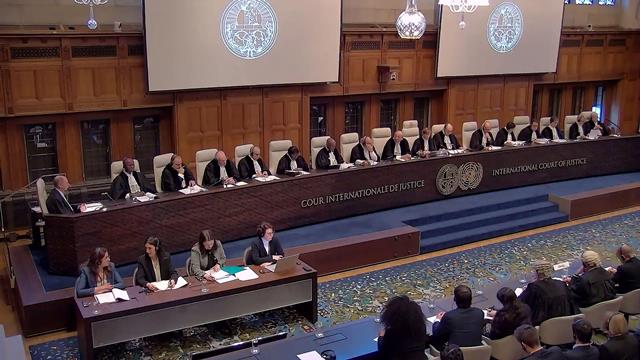
 January 2024: The ICJ courtroom ahead of an interim ruling in the Gaza genocide case against Israel made by South Africa in the Hague. [photo: by ICJ/ UPI/Alamy]
[This is an excerpt from an article in The Round Table: The Commonwealth Journal of International Affairs and Policy Studies. Opinions expressed do not reflect the position of the Round Table editorial board.]
Genocide cases can take many decades to get to court, if they make it to court at all. In the case of South Africa v Israel,Footnote1 South Africa was quick to act. On 29 December 2023, less than four months after the outbreak of the Gaza war, South Africa brought proceedings against Israel at the International Court of Justice (ICJ). Fundamentally, South Africa alleged that Israel’s conduct in the Gaza strip violated their obligations under the UN Genocide Convention.
South Africa requested the ICJ to issue preliminary measures and framed its case for the commission of acts of genocide within the broader context of Israel’s conduct towards Palestinians during decades of discriminatory policies against Palestinians, amounting to apartheid. South Africa’s case focused on the 1948 Convention on the Prevention and Punishment of the Crime of Genocide (the ‘Genocide Convention’). South Africa’s justice minister, Ronald Lamola, led a top legal team which argued that Israel was committing genocide against Palestinians in Gaza and in so doing violating the Genocide Convention. South Africa asked that the court bring provisional measures against Israel, that Israel be ordered to immediate cease its military operations and that Israel should take all reasonable measures within its power to prevent genocide.Footnote2 In response, Israel argued that it was conducting a war of self-defence.
Following two days of public hearings in January 2024, the ICJ held that there was a plausible case of genocide for Israel to answer. The court ordered provisional measures, ordering Israel to take all measures to stop actions contrary to the Genocide Convention. The court however stopped short of ordering a ceasefire. The court also expressed concern about the fate of the Israeli hostages (at that point, there were 136 hostages held by Hamas in Gaza). The ICJ ordered Israel to take all measures within its power to prevent the commission of all acts within the scope of Article II of the Genocide Convention, and to take immediate and effective measures to enable the provision of urgently needed basic services and humanitarian assistance to address the adverse conditions of life faced by Palestinians in the Gaza Strip.
Not just about international law
Barking at the Big Dogs: South Africa’s Foreign Policy Towards the Middle East
A glaring shortcoming of the order was that the court stopped short of ordering a ceasefire. Whereas the court’s unwillingness to order a ceasefire has been criticised, it has been argued that for Israel to comply with the order, the Israeli government would have to seize or scale down their military operations in order to guarantee the provision of basic services and humanitarian services to the population of Gaza. This, some believed, meant that the order in effect required a ceasefire. It would, however, have had important significance (at least symbolically) for the ICJ to have ordered a ceasefire. In light of the current ongoing failed attempts to reach a ceasefire since the resumption of the Israeli Defence Force’s (IDF) military operations in Gaza on 18 March 2025, it is clear that a ceasefire lies at the heart of the political, legal and humanitarian crisis.
By focusing on genocide, South Africa has entered into necessary but tricky legal terrain. Genocide is notoriously difficult to prove, essentially because it requires proof of genocidal intent. It must be proved that the intent existed to destroy a protected group as a protected group. A protected group refers to a national, ethnic, racial or religious group. The provisional order judgement was only the first step in what is expected to be prolonged litigation before the ICJ. The provisional measures case preceded the case on the merits which can take many years. The last major step was South Africa’s submission of a comprehensive statement of evidence on 28 October 2024. Israel had until 28 July 2025 to respond to this statement. It is expected that the question of the presence of genocidal intent will lie at the heart of the ‘main’ case.
It has long been asked whether the ICJ is an effective or appropriate forum to hear disputes involving international criminal law, and genocide in particular.
Mia Swart is Visiting Professor, University of the Witwatersrand, Johannesburg, South Africa.