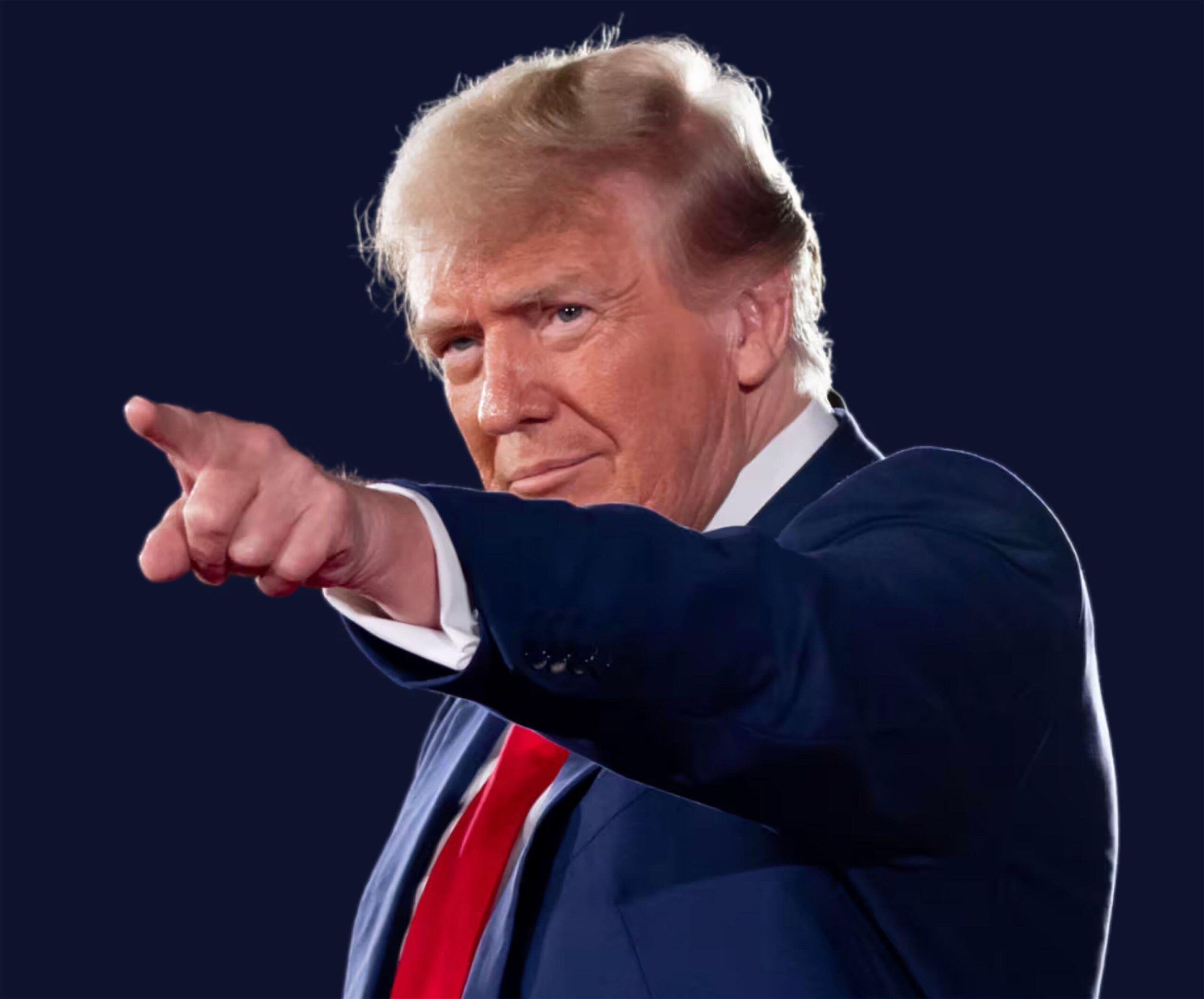
 February 2025: President Donald Trump. [photo: White House/ Alamy/ Pictorial Press Ltd]
[This is an excerpt from an article in The Round Table: The Commonwealth Journal of International Affairs and Policy Studies. Opinions expressed do not reflect the position of the Round Table editorial board.]
South Africans are still trying to make sense of President Cyril Ramaphosa’s encounter with President Donald Trump on Wednesday, 21 May 2025, and are finding no certain answers. Ramaphosa was venturing into the White House with the intent of responding to the US’ imposition of tariffs on South African imports and closure of South Africa’s access to the Agriculture Growth Opportunity Act (AGOA); the latter poses a huge threat to South African agricultural exports, its exports of cars and other goods to the US market.
At issue, before the meeting, was how Ramaphosa, or any other government leader for that matter, should seek to deal with such an erratic leader for whom there is no apparent distinction between fact and fiction, for whom politics and diplomacy are performative as much as they are substantive, and for whom, in that now much over-used word, dealings with other countries are primarily ‘transactional’. Do you butter him up, by offering him a state visit, full of pomp and spectacle (British Prime Minister Sir Keir Starmer)? Do you play to his predatory instincts, by gifting him a luxury plane (Qatar)? Or do you try standing up to him and correcting his lies (Ukraine President Volodymyr Zelensky) and risk being subject to a mauling by his obsequious rottweiler, Vice-President JD Vance, in the presence of the global media?
Should the Commonwealth worry about Trump 2.0?
Opinion – Trump: There will be consequences
Ramaphosa tried something else: an opening sally which talked up the advantages of the US–South African partnership, which exuded rationality and common-sense. He also stressed how, as the chairman of the forthcoming G20 forum which is being held in Johannesburg later this year, he hoped for Trump’s presence and how Trump was in line to succeed him as chairman. Trump appeared to listen courteously and nodded gravely – but then, very deliberately, changed the mood by ordering the dimming of the Oval Office lights.
On came the Oval Office television which now displayed, for all the world to see, in full technicolour and at length, footage of Economic Freedom Fighters’ leader Julius Malema and former President Jacob Zuma singing Kill the Boer to packed stadiums, along with other footage of rows of crosses, these latter purporting to be the graves of murdered white farmers, before Trump himself rifled through a large handout of gory pictures, purporting to be of brutally killed whites, lamenting dramatically ‘Death, death, death’.
This bizarre spectacle was manifestly intended as red meat to be thrown to Trump’s white nationalist supporters by rehashing his government’s ludicrous accusations of South Africa pursuing a genocide against Afrikaners, and whites more generally. Furthermore, it was played out against the backcloth of the US having pre-empted the meeting by welcoming to its shores the arrival of some 49 Afrikaner ‘refugees’ who were purported to have been fleeing the genocide. However, as COSATU president, Zingwisi Losi, pointed out to the meeting, it is overwhelmingly black South Africans, and especially women, who are the victims of crime and violence. In truth, this verity was unlikely to have been news even to the Trump administration. However, apart from the latter’s partiality for repeating the tropes of white supremacism, in realpolitik terms, the US was eager to remind Pretoria of the potential costs it could inflict on South Africa if it continued to pursue the allegations of genocide against the Palestinian people lodged by the South African government against Israel at the International Court of Justice in The Hague.
Beyond these theatrics, the seeming intent of the Oval Office ambush was to put Ramaphosa on the back foot, to humiliate him, and to throw his team’s negotiating tactics into confusion. It was a strategy which paid immediate dividends as, rather than a measured discussion of US-SA relations, the focus of the meeting was now shifted to the undeniable horrors of South Africa’s disastrously high rate of violence and crime.Footnote1 This was only reinforced by contributions, among others, by Richemont chairman Johann Rupert, who spoke about the particularly high rate of gang killings in the Western Cape and the necessity of many South Africans to live behind barbed wire. He was backed up by John Steenhuisen, the Democratic Alliance leader who was in the team as Ramaphosa’s Minister of Agriculture. Steenhuisen stressed the need for US assistance to address violent crime notably by investment from Elon Musk’s Starlink, which Musk touted as offering much needed technological capacity to the police to tackle the country’s culture of lawlessness.
There was much more which Ramaphosa had to endure, and while he must have been tempted to stomp out of the meeting to global cheers, he wisely stayed calm in the face of the rudeness of his host. Nonetheless, much damage had been done. Yes, the presence in the South Africa team not only of Steenhuisen and Rupert but of two South African golfing legends, Ernie Els and Rietief Goosen, served to counter the absurdity of the accusations of white genocide. Against that, however, the Trump ambush shone a cruel light on post-apartheid South Africa’s astronomically high rate of violent crime. Although this is largely a product of the country’s social conditions, notably massive unemployment and extensive poverty, few doubt that it is also a result of massive failures of policing, for which the ANC must accept much responsibility.
Ramaphosa’s response was to say, ‘Let’s sit down around a table and talk about it’. This was very sensible but simultaneously it was ineffective, and there could be no gainsaying that Trump’s brutal assault had inflicted considerable harm to South Africa’s reputation.
Media reports have now told that once the meeting had been brought to a merciful close, it repaired for what turned out to be a cordial lunch, where over chicken and asparagus, the mood was very different, and the US and SA delegations engaged in banter, backslapping and constructive discussion. All well and good. But what on earth are we to make of all this?
The honest answer, for the moment, must be that we don’t know.
Roger Southall is with the Department of Sociology, University of the Witwatersrand, South Africa.