
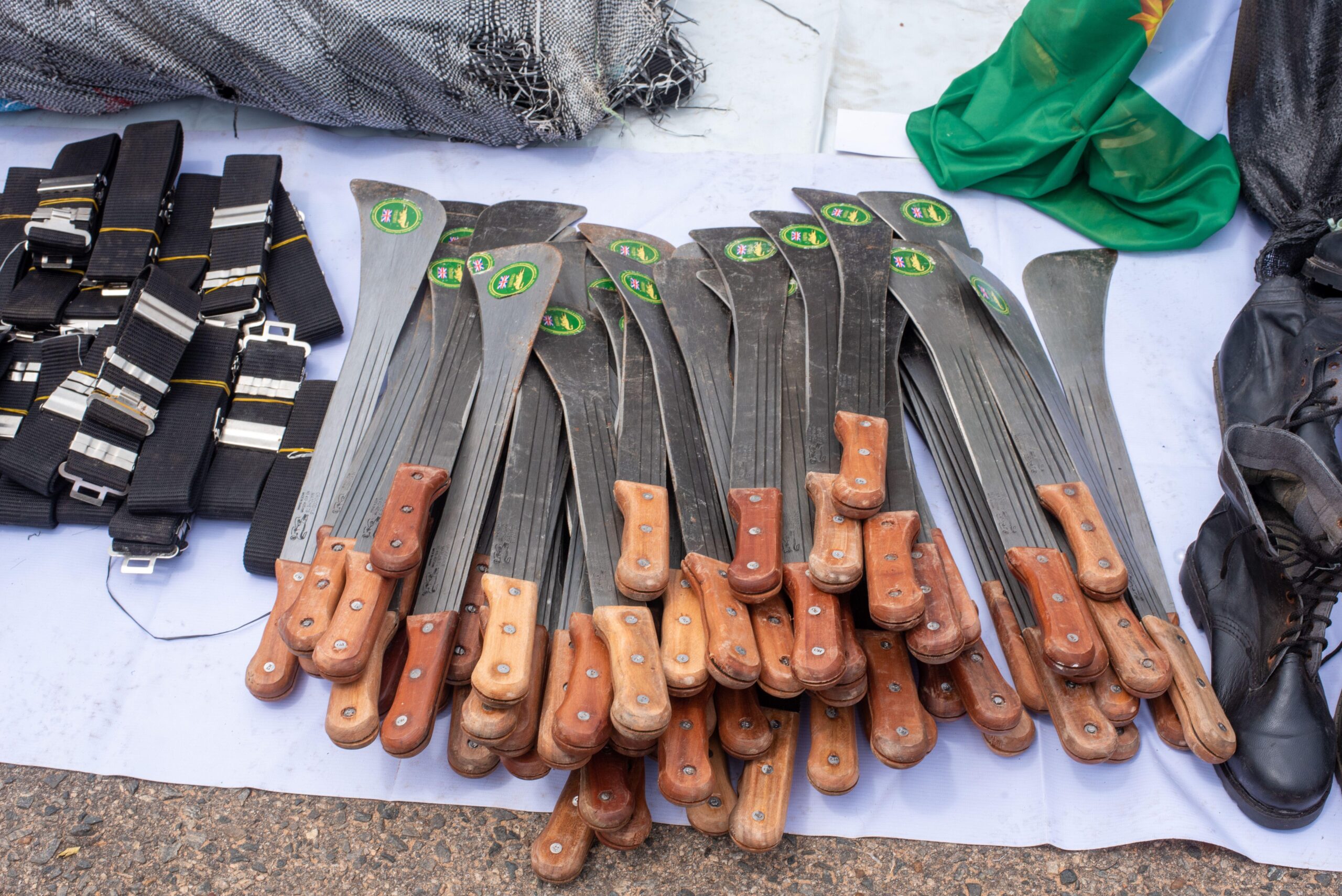
 April, 2025: Items recovered in Ibadan, Oyo. [photo: Alamy/ Tolu Owoeye]
[This is an excerpt from an article in The Round Table: The Commonwealth Journal of International Affairs and Policy Studies.]
A significant part of the overall problem with Nigerian policing is also that the Nigerian police is a highly centralised organisation. Section 214 of the 1999 Nigerian constitution states that apart from the Nigeria Police Force, ‘no other Police Force shall be established for the Federation or any part thereof’.Footnote71 The police often run a top-to-bottom arrangement where too much power is concentrated in the command headquarters. Recruitment, promotion and deployment are done centrally. However, the existing organisational structure of the Nigerian police does not suit a large and complex nation like Nigeria. State governors are supposedly the chief security officers of their states and are legally required to be responsible for the security of lives and properties within their states. However, they do not have formal control over police operations in their state. Most state governors support operations in their states with logistics, funds, and operational vehicles. However, they do so out of benevolence, not as a duty they owe the police. The present structure results in a situation where state police commissioners must take instructions from the IGP in the police headquarters at Abuja, who receives directives from the President rather than from the Governors of the states in which they operate. This has significantly affected Nigeria’s security, especially when the state governor has a different political view from the president. A typical example is Rivers State under Governor Nyesom Wike.
Policing is a local function, and familiarity with the local environment is crucial to successful policing. However, the over-centralisation of the police makes this impossible. Usually, individuals recruited into a police force must reside in the same area where they are to police. Growing up, schooling and living in the area to be policed are all important to effective policing because the individuals already understand their local communities, where the criminals are and their operational methods, as well as the language, culture and prevailing practices in that vicinity. However, in the case of Nigeria, police personnel are required by law to be ready to serve in any part of the country, whether they are familiar with the area or not. Transferring police personnel across ethnolinguistic and religious lines is inimical to effective policing. In some communities, police personnel operating there live in a different community, while police Divisional Police Officers (DPOs) visit their stations from another city. In Kogi State, one of the states in Northcentral Nigeria, some students complained that the only police station in their area closes at 10 pm, whereas the bandits attack later at night.Footnote72 It is the same throughout most parts of Nigeria. Most Nigeria’s police stations and posts are concentrated in the urban areas, which only constitute about 50% of the population, yet the activities of bandits and other criminal gangs take place chiefly in rural parts of Nigeria that are under-policed. This leaves most parts of the country with little or no contact with police institutions or personnel, making these areas a haven for bandits. Police stations are often tens of miles apart. Bandits take advantage of limited police presence to seize control of the hinterland, farmland and rural territories, imposing a brutal rule over locals. Police officers are often posted to states other than their states of residence; before they can familiarise themselves with their new terrain, they are transferred out of the state. Maintaining a consistent counter-terrorism and counter-insurgency strategy at state levels becomes challenging in these circumstances.
Organised crime, violent conflicts and the movement towards a dual policing system in Nigeria
The present structure of the Nigerian police was inherited from colonial government, but it has proven unfit for a complex society like Nigeria. Nigeria has a landmass of 923,768 square kilometres (356,669 square miles) and operates a federal system of government comprising three tiers (Federal, State and Local Government). The centralisation of the police does not align with the principles of federalism operated in Nigeria. It concentrates policing in the hands of the federal government. There have been several calls for the Nigerian police to be decentralised, and state governors and opinion leaders have called for community policing to bring the police closer to the people; however, while this call is important, it has also been criticised. Critics of police decentralisation often argue that Nigeria is not ready for this reform because of the potential misuse of the police by subnational political actors, and the perceived difficulty the subnational government will face in financing it. Most subnational governments struggle to pay the salaries of civil servants. Critics also argue that centralising the police is necessary for promoting national unity in a divided society like Nigeria. However, evidence shows that the argument against police decentralisation is relatively weak compared to the growing need to decentralise the police structure in Nigeria to tackle banditry effectively.
Conclusion
This paper has analysed the systemic weaknesses of the Nigerian police force, which contributes significantly to the failure to counter persistent issues of armed banditry. The research identifies several key factors that limit the police’s ability to maintain internal security and effectively combat armed banditry. First and foremost, the police force suffers from a chronic shortage of personnel, which is starkly inadequate when compared to Nigeria’s vast population. This hampers the police’s ability to respond quickly and effectively to criminal activities. Additionally, the police are plagued by poor funding, resulting in insufficient logistical support and outdated or inadequate equipment. This inadequacy affects operational capacity and undermines their ability to perform their duties safely and efficiently. Furthermore, the police force faces challenges related to low remuneration and poor working conditions, which negatively impact morale and contribute to high turnover rates.
Onyedikachi Madueke is with the Department of Politics and International Relations, University of Aberdeen, Aberdeen, UK.