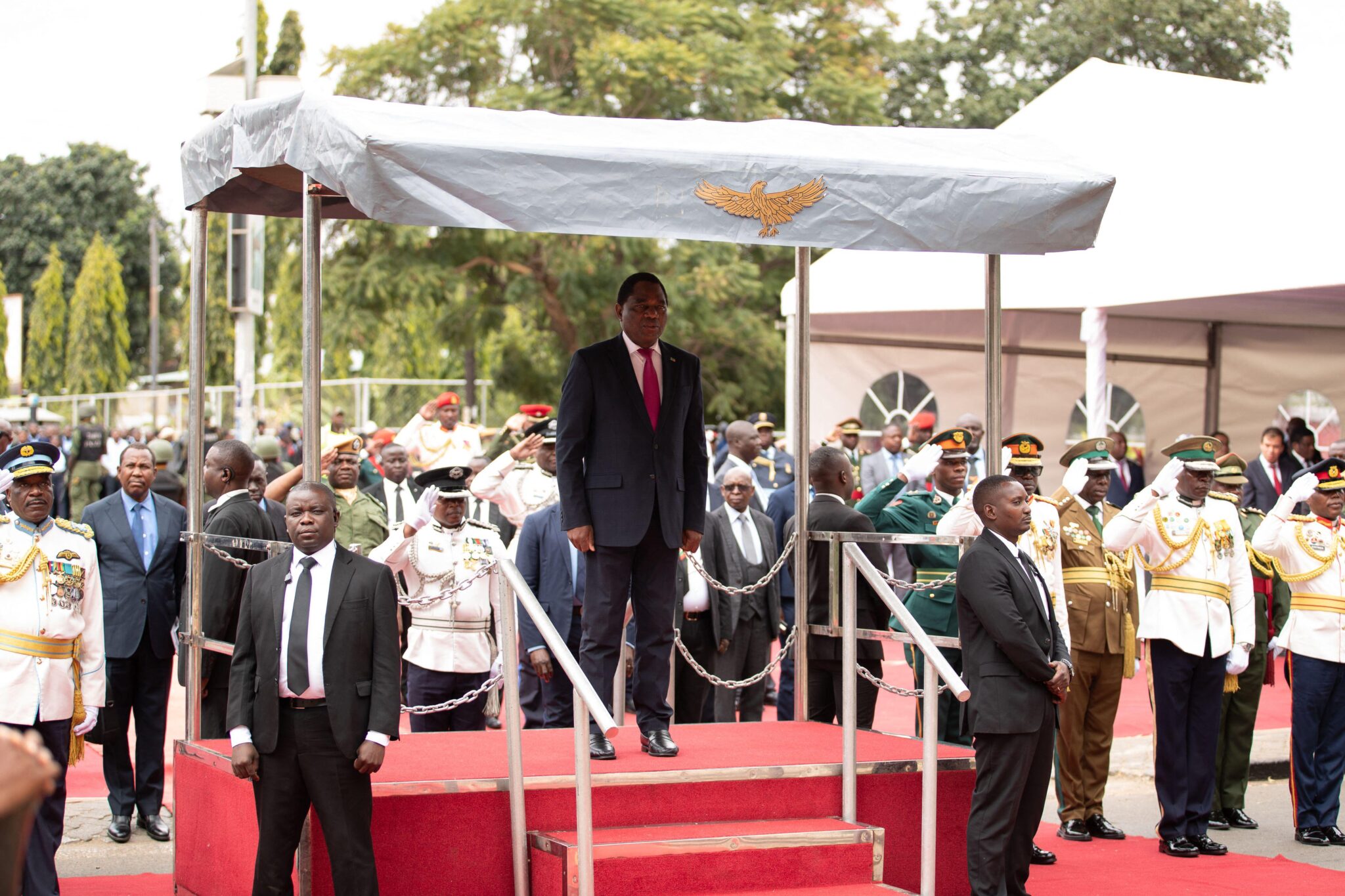
 25th May, 2025: Zambian President Hakainde Hichilema attending an Africa Day Commemoration in Lusaka, Zambia. [photo: Peng Lijun/Xinhua/Alamy Live News]
[Opinions expressed in articles do not reflect the position of the Round Table editorial board.]
Zambia’s President Hakainde Hichilema won a second term this August but his victory has been plunged into controversy following revelations of voting irregularities and attacks on opposition leaders which have seen several jailed, one of them killed, and another charged with treason.
The crackdown on the opposition which also saw the main opposition leader Brian Mundubile’s house attacked by government supporters as he was forced to seek sanctuary for two weeks at a United Nations safe house in the capital Lusaka.
Opposition leaders say some campaign meetings during the election were disrupted by the police, while at the count itself proceedings were suspended for six hours following reports of violence against polling station staff and the alleged theft of ballot papers. All this has led to speculation that Zambia is moving away from democracy towards authoritarianism.
Zambia re-elects President Hakainde Hichilema for a second term
There are accusations that independent media is being stifled in Zambia. A Reuters investigation reported that Zambia was “a shrinking room for dissent”. It concluded that people are wary of speaking out online for fear of recriminations.
One opposition figure Brian Matambo says Zambia has seen what he called “a steady erosion of democratic space” since President Hichilema was first elected in 2021:
“We did not just land here. We did not just wake up after the 2026 election and suddenly discover that something had gone terribly wrong with our democracy. This has been coming”.
The election process itself has also given cause for concern. The European Union observer mission reported “serious and substantial concerns”, while the Zambian Election Research Network has published evidence of significant disparities in the counting of votes in at least twenty-seven constituencies where an 80% turn-out was recorded even though the national turn-out was just 57%.
The Research Network’s Dr Nicole Beardsworth from Wits University in South Africa says some have described this as “amateur hour vote-rigging”. Her Network has concluded that around 350,000 to 500,000 votes had been added to President Hichilema’s tally:
“Hichilema’s total votes were inflated by about 4% while the opposition’s votes were reduced by about 5%.”
Opposition leaders believe that the government’s security forces wanted to ensure that President Hichilema secured a two-thirds majority in parliament which would enable a change in the constitution to allow him to serve a third term which is currently illegal in Zambia. They see this as a shift from democracy to authoritarianism.
Zambia has held ten elections since 1991 when the country embraced a multi-party system. Traditionally it has been seen as a key bastion of democracy in Africa. According to Afro Barometer’s latest survey some 85% of Zambians prefer democracy to any other form of democracy. Any shifts towards more authoritarian rule will be closely monitored so all eyes are on President Hichilema’s true intentions as he begins his second term.
Peter Burdin is a former BBC Africa Bureau Chief and a member of The Round Table editorial board.