
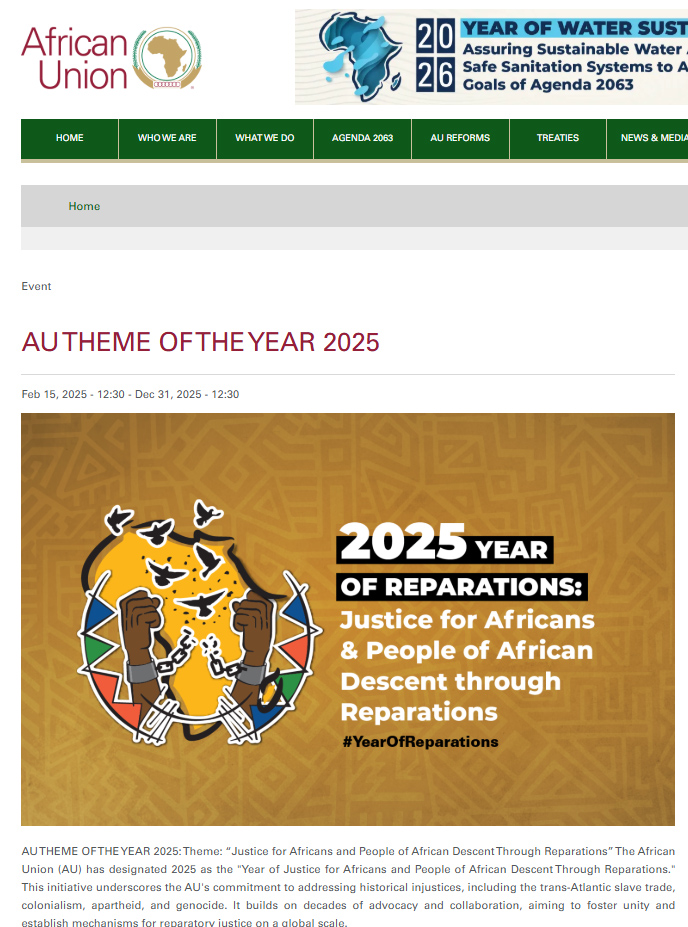
 The African Union website. [source: https://au.int/en/theme/2025]
[This is an excerpt from an article in The Round Table: The Commonwealth Journal of International Affairs and Policy Studies.]
Why now: enabling factors
As the OAU–Abiola legacy shows, reparations discussions have lingered in African regionalism for decades, but there are reasons why the expedited mainstreaming, the Assembly’s involvement, inter-regionalisation and domestication have occurred under the AU and in the last five years. The first has been an international environment that seems favourable to discussions on reparations. The UN has organised international conferences on racism and discrimination since 1978, with the most recent being in 2021. During this time, the UN declared 2015–2024 as the International Decade for People of African Descent, which inspired stocktaking within the Pan-African world regarding its historical achievements, injustices and remedies. From Jamaica, Canada, Ghana and the United States to Europe, the decade inspired cultural events, educational exchanges and new policies centred on the future of people of African descent. A recurrent element in these conversations was the need for reparations to rehabilitate and integrate Pan-African victims of historical injustices into political and economic life.
A groundswell of international support built simultaneously with the reckoning within the Pan-African world. A direct offshoot was the above-mentioned 2021 joint AU, Senegal and OSIWA cultural restitution conference, which established the organisation’s initial interest in reparations. Still within the broader international system, the conference occurred alongside the revived debate on Black American reparations. Inspired by the police murder of George Floyd in 2020, the renewed reparations debate stimulated new research, political activism and policy interventions across the United States. Created in 2015, the National African American Reparations Commission (NAARC), an organisation of scholars, artists, businesspeople and other professionals, has been pushing the agenda with the US federal government, which has not yet adopted a reparations policy. Individual US states, counties and cities, however, are either considering or have responded to NAARC advocacy by implementing projects on reparations to descendants of enslaved persons (Blake, Citation2024).
While the US federal government has not formally supported a Pan-African reparations campaign, activists, academics and policymakers who have participated in reparations discussions in Africa believe that reparations in the United States must integrate into a Pan-African campaign with Africa and CARICOM (Campbell, Citation2009, p. 147; National African-American Reparations Commission, Citation2022). Currently, there is no formalised communication on reparations between the American and African programmes, but the AU may well have taken at least three main lessons from the US scene. First, regardless of the temporal distance between enslaved people, their descendants and today’s continental Africans, the reparations issue has perpetual timeliness; the time is always right to seek justice. Second, it is clear the organisation has interpreted the revised US debate as an indicator of political and public interest in the subject, hence as a window of opportunity to advocate on the issue. Third, the specific call for a merged campaign signalled timelessness to the AU.
Along with the revived US debate, the AU’s interest likely benefited from the reparations programme of CARICOM. In 2013, CARICOM – inspired by Durban 2001 (Eugene et al., Citation2024) – decided to pursue reparations from Britain, France and the Netherlands (Edghill, Citation2013). Since then, the organisation has built an advanced programme, including the CARICOM Reparations Commission and the Prime Ministerial Subcommittee on Reparations. Additionally, all 14 member states have domesticated this campaign by creating respective National Reparations Committees (Bousquet, Citation2023). According to Professor Beckles, Chair of CARICOM’s Reparations Committee, the organisation’s campaign is credited with inspiring debates and apologies from some European leaders, and revitalising discussions of the HR-40 Bill, which aims to create a commission to study and develop proposals for reparations for Black Americans (Beckles, Citation2024). CARICOM is also credited with expediting the discussion of reparations in the Commonwealth. A key output of CARICOM’s campaign is the Ten-Point Action Plan for Reparatory Justice, which has informed many of the discussions on reparations in the United States as adopted by the NAARC. In addition, the plan helped California and other US states to design their own reparations programmes, making it the organisation’s ‘most important international diplomatic and political achievement to date’ (Bousquet, Citation2023). While CARICOM’s campaign has not yet yielded the desired results and still faces significant challenges, its ability to inspire international action is well documented.
While the international environment over the last decade has seemed permissive, it has relied on political leadership. In 2013, it was Dr Ralph Gonsalves, Prime Minister of St. Vincent and the Grenadines, who drove the development of CARICOM’s programme (Bousquet, Citation2023). Since 2018, Mia Mottley as Prime Minister of Barbados, and since 2025 as Chairperson of CARICOM, has expedited the process. In 2022, she gave the keynote address at Ghana 65th Independence Day celebrations where she reiterated the need for reparations (Mottley, Citation2022). Mottley has also prioritised cooperation with the AU. In 2021, she led the organisation of the first (virtual) Joint CARICOM–AU Summit. As keynote speaker, she addressed the February 2025 Summit of AU Heads of States in Addis Ababa and repeated the reparations call (Chanzo, Citation2025). She then announced ongoing preparations for the first (in-person) Joint AU–CARICOM Summit in Ethiopia, in September.
Another Caribbean leader who has helped form the AU–CARICOM reparations discussion is Professor Hilary Beckles, Vice-Chancellor of the University of the West Indies and Chair of CARICOM’s Commission on Reparations. Ready to retry after the ‘Durban betrayal’, he has reported that the Commission initiated its reparations diplomacy to the AU in 2017 and has since invited the African organisation to form a Pan-African front. He believes that CARICOM partially influenced the AU’s decision to declare 2025 the Year of Reparations in solidarity with CARICOM’s cause (Beckles, Citation2024). Additionally, the AU’s Eight Demands and CARICOM’s Ten-Point Plan for Reparative Justice share similarities, especially the concept of reparations as a tool for economic transformation (Eugene et al., Citation2024, p. 33). This similarity likely resulted from the cross-fertilisation of ideas between the two organisations.
Leadership from CARICOM worked alongside Ghana’s presidency to help mainstream reparations in the AU. Ghana’s leaders promoted reparations during the hibernation era of the 1990s when late former President Jerry J. Rawlings hosted the First and Second Accra African World Reparations and Truth Commission in 1999 and 2000, respectively. Building on these long-standing practices of promoting psychological unity and solidarity, Ghana’s immediate past president Nana Addo Dankwa Akufo-Addo entrenched the importance of ‘return’ to the continent and directly influenced the AU’s reparations agenda. In 2019, his government organised the ‘Year of Return’ programme to mark the 400th anniversary of the beginning of the trade in enslaved Africans. This year-long programme of conferences, concerts and educational events invited diaspora generations to learn about and (re)connect to Ghana and Africa.
‘A partnership for everyone’: The case for a strategy on reparatory justice
Reparations for Slavery Becomes A Commonwealth Issue
Research Article – An African Union-Caribbean Community alliance in the global reparations movement: promises, perils, and pitfalls
Sorry is not the hardest word – reparations is
Reparations for slavery: A Commonwealth Journalists Lecture delves into the moral and economic dues
Ghana’s programmes have been a more consistent institution of the rights to return and residence, part of the above-mentioned internal reparations and healing that are constitutive of the Pan-African approach to reparations. Beyond the Return, the Year of Return’s sequel has since 2020 included an annual diaspora pilgrimage to Ghana in December for arts, education, conferences and investment drive, often capped by citizenship ceremonies for eligible diaspora returnees. Akufo-Addo’s government considered diaspora return emotionally as a ‘landmark spiritual and birth-right journey’ and strategically as tourism and investment earners for economic transformation under the Ghana Beyond Aid agenda (Government of Ghana, Citation2019). By describing return as a birthright, the government implied that, but for the trade in enslaved people, the returnees would never have left Africa. Their right to return and reside, therefore, is a restoration of this inalienable right and a step towards internal reparation the Pan-African community.
Ghana made its official stance on reparations in Accra in August 2022 at the Advancing Justice: Reparations and Racial Healing summit that the AU and CSOs supported. With representation from governments, academia, activism, the religious and business worlds from North America, the Caribbean, Europe, Central and South America, this conference, held months before the ‘Return’ festivities of the year, was perhaps the most representative gathering on reparations organised in Africa. In his keynote address, Akufo-Addo expressed solidarity with the Reparations Movement within the Pan-African world and promised to champion the issue personally. He stated ‘the importance of the African Union making reparations a priority issue, setting an expectation for the engagement of other African Heads of State to join with African people and people of African descent globally, in this endeavor’ (NAARC, Citation2022). Ghana’s expectation that the AU will lead the process was further strengthened.
After the conference, Ghana prompted the AU to mainstream reparations. At the AU Summit in February 2023, six months after Ghana’s August 2022 Conference, African leaders approved Ghana’s proposal to organise the Accra Conference on Reparations, which produced the Accra Proclamations on Reparations in which the AU affirmed with ‘deep appreciation, the work led by the Permanent Representative of the Government of Ghana to the African Union in conceptualizing, formulating and shepherding the conduct of the Conference and other pre-conference activities’. Participants agreed to:
commit to supporting the advocacy campaign headlined by President Nana Addo Dankwa Akufo-Addo and the Republic of Ghana for the reform of the global financial infrastructure with a view to achieving a new global financial pact that is reparatory in nature and economically equitable in scope and practice. (African Union, Citation2023).
Here, the AU left no doubt that its current reparations campaign was prompted by the government of Ghana.
The country’s leadership on reparations, this time under new President John Mahama, yielded global results in March 2026 when the UN General Assembly adopted the Declaration of the Trafficking of Enslaved Africans and Racialized Chattel Enslavement of Africans as the Gravest Crime against Humanity, which condemned slavery as ‘the gravest crime against humanity’ and endorsed the Pan-African reparations programmes. This feat, like other mainstreaming efforts, ran on formalised and regular interactions between African and diaspora leadership. It epitomises and cements what Ake called Pan-Africanist psychological unity among the leadership of countries, in this case on reparations.
Oheneba A. Boateng, Political Science, Clark University, Worcester, USA.