[This is an excerpt from an article in The Round Table: The Commonwealth Journal of International Affairs and Policy Studies.]
The book moves fluidly between personal reflection and broader analysis. The passages in which Anwar [Ibrahim] recounts his years in detention are among the most compelling. Prison, he recounts, stripped away illusions and forced a confrontation with the human capacity for both cruelty and compassion. These experiences deepened his conviction that genuine leadership requires empathy, moral consistency, and a willingness to question one’s own assumptions. He draws on an eclectic range of sources: Ibn Khaldun’s cyclical theory of civilisations, classical Islamic scholarship on governance, and selected modern Western thinkers like John Rawls, to construct what he calls an ‘inclusive synthesis’.
The result is a vision of global order that seeks to reconcile Eastern and Western intellectual heritages while prioritising sustainability, compassion, and innovation. For scholars of political philosophy and Islamic political thought these sections offer substantial material for engagement on the issue of democratisation. Anwar stays away from dense jargon while still conveying complex ideas, and the autobiographical elements help ground abstract arguments in lived reality. His critique of global injustices, such as Islamophobia, colonial legacies, and the moral failures of contemporary power structures, will resonate with readers who feel that established world liberal frameworks have not adequately addressed the concerns of Muslim societies.
In the Malaysian context, where Islam is the religion of the Federation, the book’s insistence on the compatibility of Islam and democracy challenges persistent stereotypes and holds out the possibility of progressive reform. Yet any serious reading of Rethinking Ourselves must confront an uncomfortable truth. The ideals Anwar articulates so persuasively on the page sit uneasily alongside the political record of his administration since he became prime minister in 2022. The Unity Government he leads depends on a formal alliance with UMNO, the party he spent much of his political career criticising for entrenched corruption, patronage, and authoritarian tendencies. In 2025, high-profile corruption cases involving senior UMNO figures, notably Deputy Prime Minister Ahmad Zahid Hamidi, were discontinued or downgraded. These developments have been interpreted as pragmatic trade-offs made to preserve political survival rather than as principled advances in the fight against corruption. They sit in sharp contrast to the book’s unequivocal condemnation of systemic plunder and unaccountable power.
Special edition of the Round Table Journal – Malaysia: The 15th general election and its implications
Hung parliament, coalition government and the rise of the Islamists – Malaysia after the 2022 election
A comparable gap appears in the management of Islamic affairs. Anwar presents Islam as a faith of universal mercy and inclusivity, yet Malaysian federal and state Islamic institutions, particularly JAKIM, have maintained, and in some instances intensified, practices that many non-Muslims experience as restrictive and oppressive. Continued monitoring of Christian outreach activities, insults on Hindu religion by Muslim converts, and the unresolved enforced disappearance in 2017 of Pastor Raymond Koh, who was targeted due to allegations of proselytising to Muslims, remain points of deep concern for Malaysia’s non-Muslims. The arrests of Shia Muslims and state-supported attacks against the LGBTQ communities likewise continued with little sign of moderation. Anwar’s vocal international advocacy, particularly on Gaza, has earned him considerable goodwill in many parts of the Muslim world and beyond. Domestically, however, the same moral clarity is harder to discern. His actions have steadily eroded the reformist commitments once associated with Anwar and the Reformasi movement he helped inspire.
In conclusion, Rethinking Ourselves is intellectually stimulating, offering a nuanced Islamic perspective on contemporary crises. Yet its author’s political choices ruling Malaysia exposes it as aspirational rhetoric far removed from reality. Anwar, like many politicians, excels as a political philosopher but falters in practice, guilty of preaching democracy while entrenching authoritarian tendencies, and universal Islam while tolerating repression of other faiths. This dissonance not only diminishes the book’s impact but highlights a broader malaise in leadership: the gap between words and deeds. For Malaysia to truly rethink itself, it needs leaders who live their philosophies, not merely articulate them.
James Chin, University of Tasmania.
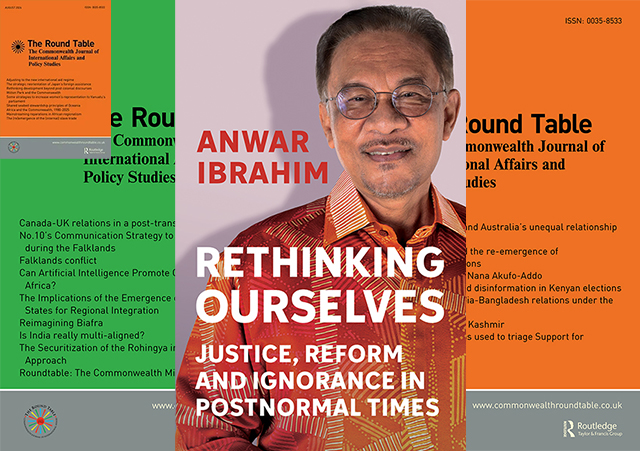
Rethinking ourselves: justice, reform and ignorance in Postnormal Times by Anwar Ibrahim, London, Hurst, 2025.