
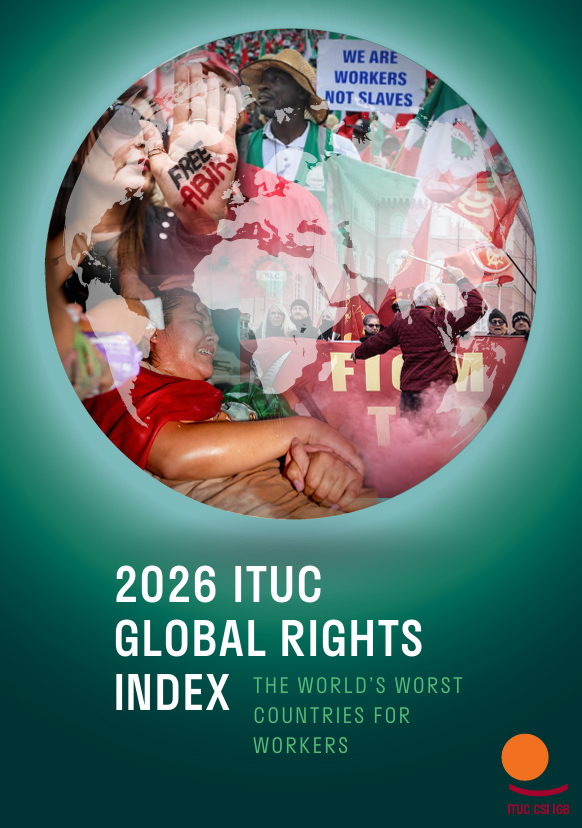
For the second year running, workers’ rights in Commonwealth countries have improved, against a backdrop of continuing deterioration in other parts of the world.
The authoritative Global Rights Index, released in June at the ILO annual conference in Geneva by the International Trade Union Confederation, showed improvements in workers’ rights in Botswana and the United Kingdom on top of the improvement last year in Australia. These may be marginal improvements, but they are bucking the trend around the rest of the world.
This year, only one non-Commonwealth country (Uruguay) saw an improvement in labour rights, and the Commonwealth now stands out as the only part of the world bettered by Europe (and even there the picture is worsening) compared with the situation three years ago when the Commonwealth was one of the worst performing areas of the world.
This year, Commonwealth countries also outperformed their neighbours in Africa, the Americas and Asia-Pacific. And the worst region in the world for workers’ rights, the Middle East and North Africa, is the only region without a Commonwealth country.
Ranking countries’ performance against 96 different indicators drawn from ILO and other UN instruments, the Global Rights Index allocates each country surveyed from 1 to 5, with 1 being the best, and a special 5+ category for the 12 failed states described as having “no guarantee of rights due to the breakdown of the law” (none of them Commonwealth countries).
On average, this year, the average score globally was 3.70, but the Commonwealth average was 3.46 – improved from 3.56 in 2024 and 3.54 a year ago. These are small improvements (although over many countries, and given that the pace of change in labour laws can often be slow, rapid change is unlikely.) Most important is the direction of travel. As workers’ rights continue to worsen globally, they are improving in Commonwealth countries, however marginally.
And whereas the average for countries outside the EU this year was 4.42, the predominantly non-EU Commonwealth average of 3.46 (Cyprus and Malta, the only Commonwealth countries in the EU since Brexit, were not covered in this year’s survey) looks even more impressive.
The six best performing countries in the Commonwealth (those categorised as experiencing “repeated violations of rights” rather than the best category involving only “sporadic violations of rights” where there are no longer any Commonwealth countries) were Australia, Barbados, Ghana, Malawi, New Zealand and Singapore.
The situation in Commonwealth countries is not all rosy, though. Two Commonwealth countries, eSwatini and Nigeria, are among the ten countries identified by the ITUC as the worst places in the world to be a trade unionist. NLC Nigeria President Joe Ajaero was this month awarded the Norwegian Arthur Svensson International Prize for Trade Union Rights in recognition of the harassment he has suffered while leading his movement – including arrests and arson attacks on his family home. And six Commonwealth countries were listed in the worst category of “no guarantee of rights”, although that was a small proportion of the 41 countries worldwide in that category.
Even among the worst performing countries, though, and again as a result of worsening rights elsewhere, there had been three Commonwealth countries among the ten worst places to be a trade unionist in 2025. And at the ILO Committee on the Application of Standards at the ILO Conference in June, where the worst individual cases of rights breaches are considered, the number of cases on the long list from Commonwealth countries fell this year to 8 out of 40, compared with 12 out of 40 last year.
Although the Global Rights Index covers 151 countries, only 35 of the 56 Commonwealth member states are covered, mostly because smaller island states – so common in the Commonwealth – are often not included. However, since the larger Commonwealth countries are often the least well performing, and those small island states in the Index are often among the better performers, a wider coverage might only improve the Commonwealth track record on union rights.
Owen Tudor is the Secretary of the Commonwealth Trade Union Group, the Chair of the Commonwealth Human Rights Initiative and a member of the Round Table editorial board.
Related articles:
Could do much better – Workers’ rights in Commonwealth countries