
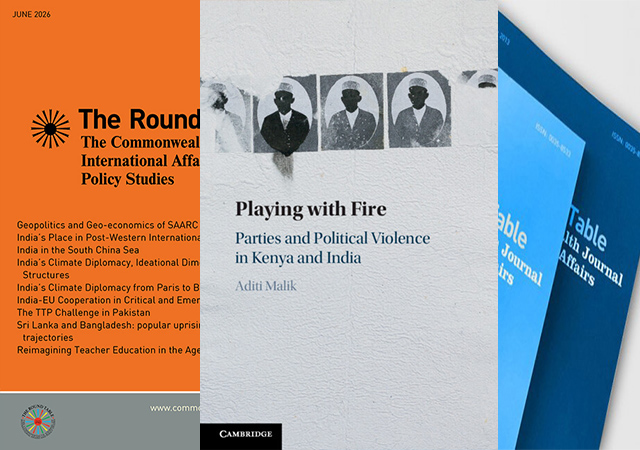
[This is an excerpt from an article in The Round Table: The Commonwealth Journal of International Affairs and Policy Studies.]
Comparative studies of politics in different Commonwealth countries are well worth undertaking. Most member states are often somewhat, or indeed very comparable. They start at independence with roughly similar legal, administrative and political systems and then they diverge in interesting ways. The contrasts and commonalities between them reveal things that analyses of any country in isolation cannot. Sadly, however, there is a distinct shortage of such comparative work.
Aditi Malik has addressed it by examining the inter-relationships between political parties, civil society organisations and political violence in Kenya and India. She offers a new and intriguing approach that will enrich our work on these issues. She sensibly focuses on both the national and local levels in these countries, to argue that when serious outbreaks of political violence occur, parties and their leaders count for more than civil society organisations which usually seek to avert mayhem.
This is somewhat familiar. But she then offers a fresh insight by arguing that politicians’ inclinations to foment or to avoid violence depend in part on the party systems in which they operate. When there is relative stability within and between the main parties that vie for power, leaders will be less tempted to initiate violence. If one or more of the main parties lack a stable hold, then that temptation intensifies. She uses evidence from recent decades to make a reasonably plausible case.
That is valuable, but there are also serious problems with the analysis. First, something fundamental is missed. The Kenyan and Indian cases are compared as like for like, but in one crucial respect, they contrast radically. Before 2002, Daniel arap Moi in Kenya headed a brutish tyranny. This writer was an eye-witness to its barbarity and to the terror that it created among enlightened figures. But after Moi, a new and admirable Constitution was adopted in 2010 which has enabled pluralism and genuinely democratic government to gain ground. By contrast, since 2014 when Narendra Modi became India’s Prime Minister, systematic efforts to promote religious bigotry and to suffocate democracy have made great headway.
Commonwealth Bookshelf
In other words, these two countries have been moving in opposite directions. This is clearly relevant to an analysis of the political logic underpinning outbreaks or the avoidance of sectarian violence. But it is not made evident in this study.
A second difficulty arises when the author turns to civil society. An Appendix on the ‘Development’ of civil society in the two countries, argues – correctly as noted above – that civil society organisations are unable to prevent politicians from initiating violence. But when we move beyond that, we encounter problems.
The creation of Kenya’s new Constitution was partly enabled by civil society – and since its enactment, civil society has indeed made gains there. But when the discussion turns to India, something vastly important is overlooked. Civil society there has not undergone ‘development’ under the Modi government. Since he took power in 2014, a huge number of civil society organisations – apart than those that assist in brutalising the large Muslim minority – have been systematically intimidated or crushed. This process has been successful and quite brazen. Its targets include two Nobel Peace Prize winners, Amnesty International – which has been forced to leave India – and even Mother Teresa’s Missionaries of Charity.
Nor do the author’s comments capture the immensity and intensity of the barbaric attacks on Muslims under Modi. She describes ‘targeted attacks against minorities’ as ‘mild’ (p. 189). This is frankly bizarre. India has seen hundreds of beatings and murders, mainly of Muslims on flimsy (or no) grounds – on which the Prime Minister remained silent for over two years. And there are no comments on a widely employed tactic by Hindu extremist organisations, and indeed state governments headed by Modi’s party. Bulldozers are deployed, impetuously and without due process, to flatten homes and shops – again, mostly of Muslims.
James Manor, Institute of Commonwealth Studies, University of London.
Playing with fire: Parties and political violence in Kenya and India by Aditi Malik, Cambridge, Cambridge University Press, 2024.