
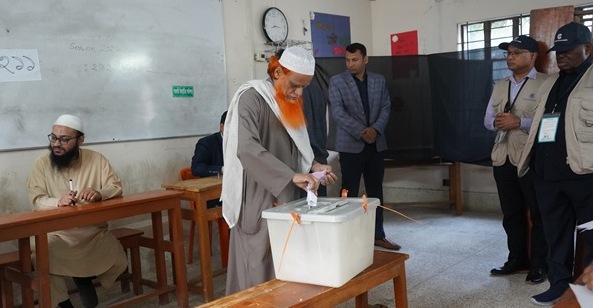
 February 2026: The Commonwealth Observer Group team in Bangladesh. [photo: ComSec Flikr]
[This is an excerpt from an article in The Round Table: The Commonwealth Journal of International Affairs and Policy Studies.]
The [National People’s Power] NPP’s main focus has been to stabilise the economy since it is confronted with a plethora of challenges: of the need to tackle unsustainable debt, debt restructuring, corruption and bloated bureaucracy, while bringing in stability and growth. The government has removed some of the benefits given to former heads of state, such as administrative costs and ministerial privileges to reduce unnecessary spending and has also launched investigations against bureaucrats, former Members of Parliament, members of the judiciary, members of the police and those in the private sector, on grounds of corruption (Senanayake, Citation2025).
At the same time, there has been a discernible shift in discourse from identity politics to the politics of unity by stressing equal citizenship. This narrative has enabled the NPP to engage minimally on issues of reconciliation and resolving ethnic questions. While the government has claimed that approximately 672 acres of land in Northern and Eastern areas have been returned to its original owners (Jayasuriya, Citation2025), the military continues to occupy some areas. The government has also not taken concrete steps to stop the Department of Archaeology, the Department of Wildlife Conservation and the Department of Forest Conservation from continuing illegal land grabs under the ruse of environmental issues or reviving lost Buddhist sites in predominately minority areas.
In contrast, at the time of writing, it is too early to make a similar assessment of the new government in Bangladesh in terms of identity politics to politics of unity. The main concern thus far is early signs of executive excesses by the [Bangladesh Nationalist Party] BNP (for example, the removal of the governor of the central bank) and the uncertainty on implementing the reform agenda. Although the BNP has rhetorically said that it will support the reform process, some of its actions indicate otherwise.
Overall, while the politics of unity and cohesion might be well intended, it risks increasing the continued marginalisation and minoritisation of minority groups that have suffered in the past. It also hampers efforts to transform or regenerate a society that has gone through decades of war and conflict.
Democratic regression in South Asia: diverging paths in five political systems
Fortunes, and much else, changes in Bangladesh
Gota gone: Sri Lankans depose Rajapaksas – but how much will change?
Perpetuation of revenge politics under a strong accountability agenda
In Bangladesh, Dr. Mohamed Yunus, a Nobel laureate, was asked by the students who led the uprising to assume the role of the chief adviser following Hasina’s ouster in August 2024.Footnote6 His ascendance to power was significant since he was deemed a merit-based and alternative leading figure to Hasina and her family’s dynastic and elitist background. Yunus represented progressive economic policy unlike the former Awami League government, which eroded key institutions with cronyism, corruption and offshore embezzlement. Hence, there were high hopes that the interim government led by Yunus in Bangladesh would usher in meaningful changes through constitutional and political reforms, re-democratising the country, making decision-making inclusive, less centralised and more accountable, and re-establishing constitutional morality and democratic ethics. The interim government undertook an ambitious agenda to reform the country’s flawed and politicised institutions and system. The interim government set up six reform commissions (which later increased to 11); these included changing the electoral system and constitution to account for those who were tortured or murdered when the AL was in power.Footnote7 The demand for prosecution of those who gravely violated human rights increased after the July uprising in Dhaka, including calls to hold Hasina (who is currently in exile) accountable, as well as her immediate family and members of the [Awami League] AL.
There was also a desire to reassess the country’s cultural and historical identity, which had been dominated by the AL in most parts of the country during the post-independence era. This has been manifested through concerted efforts to alter biased narratives through measures, such as the removal of Mujibur Rahman’s statues, the cancellation of 15 August holiday (commemorating Mujibur Rahman’s assassination), removal of Rahman’s portrait from the Prime Minister’s office, removal of Mujibur’s image from bank notes, and replacing them with designs to pay tribute to the July revolt. Footnote8,Footnote9 Furthermore, textbooks have been revised to remove ‘exaggerated history’, and redaction of the phrase ‘Father of the Nation’ when describing Mujibur Rahman. For example, in Bangladesh’s Liberation War, the revised textbook for 2025 entitled History of Bangladesh & World Civilization Classes Nine and Ten (2025), prepared by the National Curriculum and Textbook Board, quotes Mujibur Rahman’s famous March 1971 speech in which he said, ‘The struggle this time is for our emancipation. The struggle this time is for our independence’. The textbook now states (Citation2025), ‘Major Ziaur Rahman declared the independence of Bangladesh from Kalurghat Betar Center in Chittagong on 26 March. Then he declared independence again on 27 March on behalf of Bangabandhu Sheikh Mujibur Rahman.’ These measures underlined the importance of the role of culture, historical legacy and values in nation-building endeavours, especially in an environment where contested political narratives have long been appropriated by the ruling elites (Ahmed, Citation2025a).
However, there were profound concerns about whether some of these decisions were reinforcing the culture of revenge politics instead of fostering a more tolerant and inclusive culture in Bangladesh. The Yunus government banned the activities of the AL by invoking the Anti-Terrorism Act until the ongoing proceedings of the party committing alleged war crimes are completed (Bhaumik, Citation2025). Together with the army, it had launched Operation Devil Hunt, which resulted in the arrest of more than 10,000 people, including affiliates and members of the AL (Ahmed, Citation2025b).
The zero-sum approach was part of the country’s pattern of retributive politics. Debashish Nandy et al. (Citation2024) have argued that revenge politics and political violence are ideological and deeply entrenched in Bangladesh’s politics, where the country has a long historical trajectory of incumbents becoming hostile towards opposition actors after assuming power. Such violence has been perpetrated by all political parties where successive governments have contributed to the country’s intolerant and violent political cultures by taking punitive measures and curbing the political activities of opposition actors. The old generation of politicians has gradually been replaced by new ones with armed support and power, making the country’s politics more violent, undemocratic and intolerant (Nandy et al., Citation2024). However, for most of the youth, the AL’s authoritarian rule is their only memory and lived reality. For them, the enforced disappearances, political violence and electoral fraud have shaped the narrative in which the AL is the only perpetrator of violence, rather than a more balanced history. A youth-led political party, the National Citizen Party (NCP) was formed out of the Student Against Discrimination and the Jatiya Nagorik Committee (National Citizens’ Committee) in February 2025, ’dedicated to eradicating corruption, fostering national unity, and ensuring progress for every citizen. Discover our vision for a better future’. (NCP, Citation2025).
Roshni Kapur, Department of Indian Languages and Culture, University of Ghent, Ghent, Belgium, Department of Conflict and Development Studies, University of Ghent, Ghent, Belgium.