 [photo: Commonwealth Secretariat website]
[This is an excerpt from an article in The Round Table: The Commonwealth Journal of International Affairs and Policy Studies. Views expressed do not reflect the position of the editorial board.]
The work on drafting the Commonwealth Strategic Plan started over 12 months ago when the changes in the global context were only beginning to be felt. The richer member states, which fund the Commonwealth, were already facing their own difficult economic decisions and funding for the Commonwealth Secretariat had already declined in real terms over several years. In this context, the political pressure was to focus activity on achievable objectives, not to duplicate the work of other global bodies and to focus on the Commonwealth advantage. The United Kingdom government had signalled to Accredited Organisations in early 2025 that it did not support a major Commonwealth focus on social development and health, which it was argued are already served by the World Health Organisation, UNESCO and other global agencies.
The new Secretary-General, Shirley Botchwey, who took office in April 2025, faced the unenviable task of developing a Strategic Plan at speed with reduced resources in real termsFootnote2 and in an increasingly turbulent global context. It was inevitable that consultation was limited, both in terms of national consultations as well as consultation with civil society. Accredited Organisations were invited to comment on the draft plan with a two-week deadline when the ink was almost dry. The four themes of resilience included in the CHOGM 2024 communiqué (Commonwealth Secretariat, Citation2024) were reduced to three, the big casualty being social resilience. The robustly argued case for inclusion of a social resilience pillar went unheeded and unacknowledged, although there are passing references to social resilience in the Plan and in subsequent speeches (Commonwealth Parliamentary Association, Citation2025).
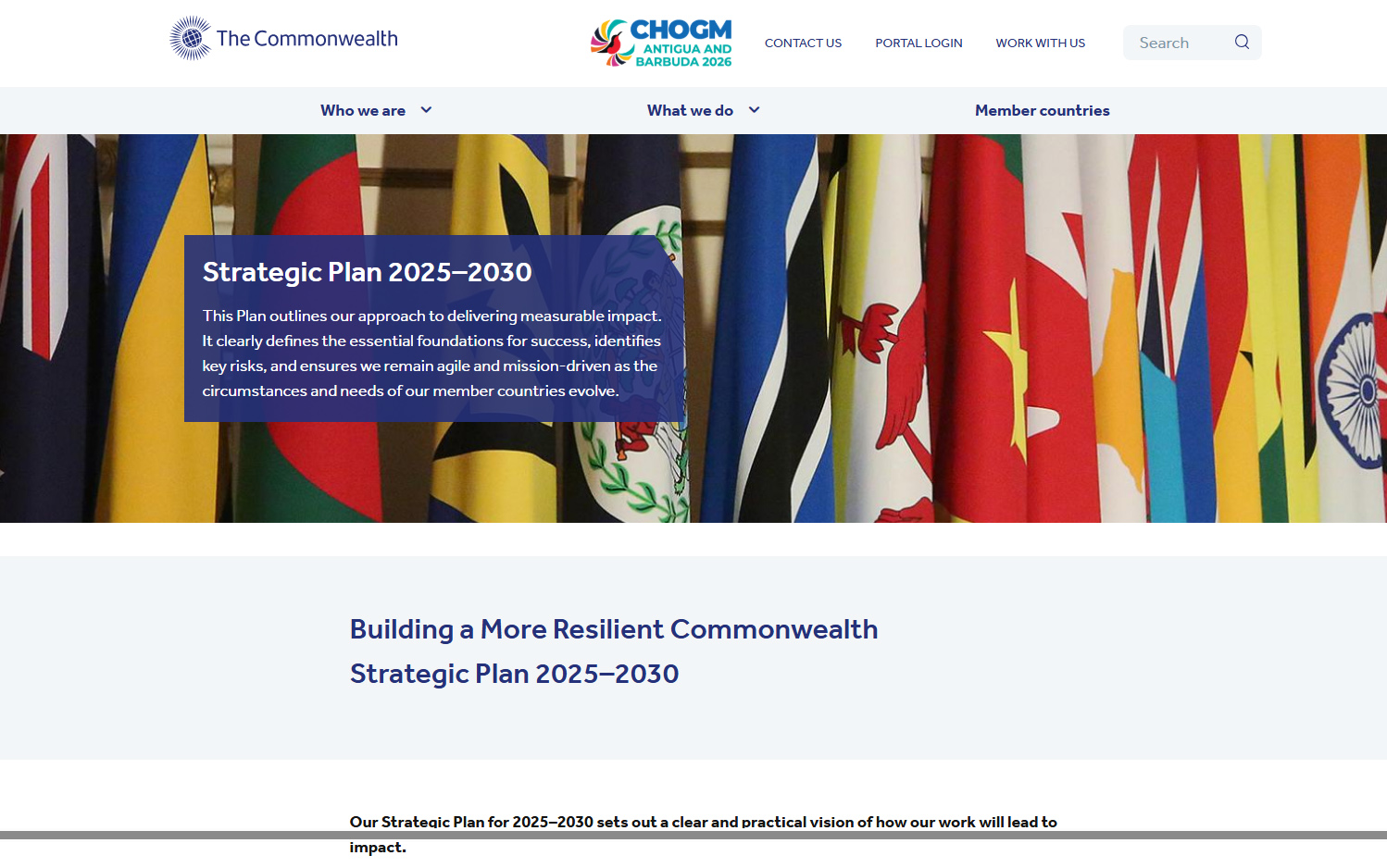
The Plan, entitled ‘Building a More Resilient Commonwealth’, has three unarguably important pillars:
- Democratic resilience
- Economic resilience
- Environment resilience.
The document argues, by focusing on democratic, economic and environmental resilience, and putting young people, women, small island developing states and other small states at the heart of everything we do, the Secretariat can help build fairer, stronger and more inclusive societies. These are not separate issues but part of a shared agenda to protect people’s rights, strengthen public trust and secure a more sustainable future for all.
Democratic resilience, involving support for elections and identifying early warning signs of democratic fragility, is at the heart of the Commonwealth USP and could not be left out; the Nadi Declaration from the 2026 meeting of Law Ministers was a powerful affirmation of core Commonwealth values (Commonwealth Secretariat, Citation2026). Environmental resilience in the context of climate change is crucial for the survival of the 25 small and island states and could not be ignored. Economic resilience is presented as the engine of Commonwealth advantage, modernising debt management, increasing trade between Commonwealth countries, fostering shared prosperity and improving access to markets for young people and women. These are all worthy objectives and important for the people of the Commonwealth, but they cannot be delivered without improved and robust education, health and social development, which are mentioned only in passing.
Democracy under distant pressure: A Commonwealth response to transnational repression
Commonwealth Day 2026: A ‘family of choice’ in troubled times
Cultures of Democracy: Commonwealth leadership, grassroots activism and people empowerment in times of crisis
Should the Commonwealth worry about Trump 2.0?
When the world is facing a crisis in resources for the basic human services on which the vast majority of Commonwealth citizens depend for their security and wellbeing, it feels profoundly shocking that the Commonwealth has been pushed into relegating them to a subservient position. For some, it must seem that the essentials of life for the majority are of lesser concern to the Commonwealth than economic success for the few. It is also becoming clear from bilateral discussions that many ministers who are responsible for these services were not consulted about the reduction in Commonwealth activity in these crucial areas. The many Accredited Organisations with an interest in health, education and social development continue to be vocal in supporting the need for a greater emphasis on these essential underpinnings of the three explicit pillars. A more confident and open focus on partnership working in developing the Plan might well have found better solutions whilst taking necessary account of the huge resource pressures faced by the Secretariat.
In parallel with the Secretariat work on the Strategic Plan, the Accredited OrganisationsFootnote3 have concluded a major process of reflection and governance review. The Independent Forum of Commonwealth Organisations (IFCO)Footnote4 provides informal mutual support to the 97 Commonwealth Accredited Organisations, which have a formal consultative status with the Commonwealth. A new governance framework and the election of a new Chair and Steering Committee provide a framework for realising the new approach to partnerships which is envisaged in the Plan. This was seen at the IFCO conference on 27 April 2026 which relaunched the network in a process endorsed by all the key Commonwealth strategic partners.
Our partner ecosystem includes a network of 97 Accredited Organisations, our sister organisations the Commonwealth Foundation and the Commonwealth of Learning, as well as multilateral development banks and a host of UN and other international organisations. These partners have a wide range of expertise spread across all five regions of the Commonwealth.
By building these partnerships, the Secretariat can enable member countries to access co-ordinated support and more effectively tackle complex challenges together – including in the areas of education, health, and meeting the needs of older adults and people with disabilities (Commonwealth Secretariat, Citation2025)
It has been arguedFootnote5 that the Commonwealth is possibly the best placed international organisation to capitalise on the disruption of the current global order with the potential to provide a framework for ‘middle powers’ in partnership with small and island states. The Commonwealth is more than a collection of member states. Perhaps uniquely, the Commonwealth ecosystem involves a complex and potentially powerful nexus of political, economic and social relationships which some like to call ‘a family’. Such interconnections of ‘soft power’ are not quickly built but are quickly destroyed.
Commonwealth rhetoric has always highlighted the informal relationships between peoples alongside the formal relationships of member states, often referred to as partnerships; the Accredited Organisations are a core example of that approach and recognised as such in Article 16 of the Commonwealth Charter. The new Strategic Plan elevates the concept of partnership to an integral element of delivery, recognising explicitly that, in straightened financial times, shared resources can expand opportunities. Partnerships are envisaged with other global institutions and private sector entities as well as with the Accredited Organisations. The financial and organisational implications have yet to be made explicit. Without project funding, many AOs and other organisations would not be able to be partners.
The failure to recognise the centrality of social policy to the achievement of the three pillars leaves the impression, perhaps inadvertently, that the Commonwealth is not really interested in the daily lives of its peoples. CHOGM 2026 can correct this misunderstanding by reaffirming the fundamentals of the Charter and committing to exploring more creative partnership working with all sectors. A Strategic Plan for the Commonwealth as a whole needs to embrace all elements, which do not necessarily require heavy investment in Secretariat capacity. The focus on partnerships in the Strategic Plan almost certainly requires a change in culture and behaviour, which is not proving easy for all parties. IFCO has addressed these issues in its submission to CHOGM 2026.Footnote6
David N. Jones, Chair, Independent Forum of Commonwealth Organisations writing in a personal capacity, London, UK.