[This is an excerpt from an article in The Round Table: The Commonwealth Journal of International Affairs and Policy Studies.]
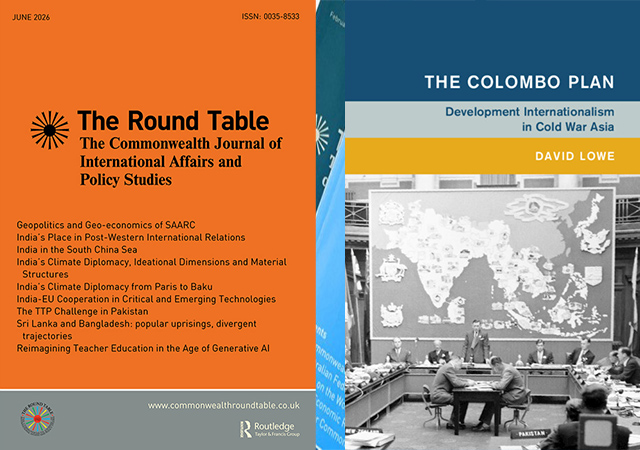
David Lowe in his comprehensive and authoritative book on the Colombo Plan highlights the way in which memory affects perceptions of this scheme. In my case as an Australian who grew up in the heyday of the Colombo Plan in the 1950s and 1960s the memory is of students coming from Asian countries to study in Australian universities. While there were also Asian students who came as private students or with the support of other organisations such as churches, the Colombo Plan students became part of the public consciousness, humanising the interaction between Australia and Asian countries while also broadening the experience of Australian university students at the time. So much was this the Australian memory of the Colombo Plan that when the Australian government instituted a scheme in 2014 to support Australian students going to Asian countries it called the programme the New Colombo Plan. The positive experience with Colombo Plan students in the 1950s and 1960s prepared the way in subsequent decades for Australian universities to receive huge numbers of Asian students to the point that the system is now financially dependent on this source, with up to half the students in some of the research universities being international, and even more in some faculties and courses.
Lowe does not go into this latter issue. His focus is the Colombo Plan as such, showing how the programme developed from the perspective of ‘development internationalism’. The book demonstrates in a specific context how development was understood, highlighting the interaction between donors and recipients. Three broad themes run throughout the book, covering state making, internationalism and experimental regionalism (p. 14). How did the Colombo Plan contribute to the strengthening of the states of the region, many of which had recently undergone or were undergoing decolonisation? What was the nature of the international arrangements set up under the Plan? How did the Plan contribute to a sense of regionalism, remembering that while initially the focus for the Colombo Plan was South and Southeast Asia, there have been competing regional constructs that might consider South Asia and Southeast Asia separately or focus on broader ‘regions’ such as Asia-Pacific or Indo-Pacific?
Democratic regression in South Asia: diverging paths in five political systems
Sri Lanka @75 : Perils of complacency in a fragile nation
Gota gone: Sri Lankans depose Rajapaksas – but how much will change?
The book develops these themes in six substantive chapters and a concluding Coda that are broadly chronological. The author has done an immense amount of detailed archival work in English-speaking countries, especially Australia and the United Kingdom but not confined to those countries. Chapter 1 covers the founding meeting of Commonwealth foreign ministers in Colombo in January 1950, with representation from the United Kingdom, Canada, Australia, New Zealand, India, Pakistan and Ceylon. The Plan could well have been named after Percy Spender, the Australian foreign minister, but for his surname. Chapter 2 shows how the Plan broadened from the initial Commonwealth focus to include the United States, Indonesia, Burma, Nepal and the French Associated States of Laos, Cambodia and Vietnam by 1953. In Chapter 3, covering the mid-1950s, further expansion included Japan, the Philippines and Thailand by 1954, with Japan’s entry being part of that country developing a more ‘normal’ international role. Chapter 4, focusing on three Consultative Committee meetings in Saigon (1957), Seattle (1958) and Djakarta (1959), throws light on the different perspectives of countries involved in the scheme. Chapter 5 on the early 1960s covers the Consultative Committee meetings in Tokyo (1960), Kuala Lumpur (1961) and Melbourne (1962), also giving some attention to the significance of Japan’s membership and the nature of some key projects; from this high point in the early 1960s the Colombo Plan gradually declined in status, reviving in a modified form from the 1980s. The Coda highlights the issue of memory in interpreting the Colombo Plan.
The book has a magisterial air. It will remain the definitive study for some time.
Derek McDougall is with the School of Social and Political Sciences, University of Melbourne.
The Colombo Plan: development internationalism in Cold War Asia by David Lowe, Cambridge, Cambridge University Press, 2025.