 [photo: The Commonwealth Secretariat.]
[This is an excerpt from an article in The Round Table: The Commonwealth Journal of International Affairs and Policy Studies. Views expressed do not reflect the position of the editorial board.]
When news spread about Jamaludin Taibapu, an Indonesian man who tried to swim to Singapore in search of work (Bhattacharjya, Citation2025; Nariswari, Citation2025), the reaction was one of disbelief and sadness. He was caught, sentenced to prison and caned. Jamaludin’s act was not merely a breach of law; it was a small, desperate message from someone who believed that no one was listening.
For those of us who study communication and migration, his story speaks louder than policy documents ever could. It shows what happens when dialogue between policy and people breaks down. Migration, at that point, becomes both a language of survival and a plea for recognition. For many Indonesians from poorer provinces, migration is not simply about earning money. It is about dignity and about being seen. In my own study of migrant motivations (Anggara et al., Citation2024), one respondent said quietly, ‘Working abroad is my way of proving that I matter’. People move not only to escape poverty but to be heard in a world that so often forgets to listen. According to the International Labour Organization (Citation2024), Southeast Asia remains one of the world’s busiest migration corridors, sustained largely by informal routes that leave millions unprotected.
Sadly, those realities rarely find their way into government discourse. The Indonesian state celebrates its pahlawan devisa, or ‘heroes of foreign exchange’, yet behind the praise lies distance. Policy is written in economic terms rather than human ones. Komnas HAM Indonesia [HAM] (Citation2023) has long reminded policymakers that protection must begin before departure, not after tragedy. However, such advice often disappears into bureaucratic routine.
Singapore’s reaction to Jamaludin’s act added another layer of sorrow. The city-state prides itself on order and discipline, values often linked to the Commonwealth tradition. The law may have been applied correctly, but justice was not served. As Amnesty International (Citation2010) has documented, caning remains a legal punishment in Singapore, and many migrant workers still face inadequate protection despite their essential contributions to the economy.
This is not an isolated incident. Some years earlier, a similar case occurred in Malaysia when an Indonesian worker was shot near the border (Sianturi et al., Citation2025). In Malaysia, immigration enforcement still relies on lengthy detention, limited access to legal aid, and possible corporal punishment for those who enter without documents (Asian-African Legal Consultative Organization & United Nations ESCAP [ESCAP], Citation2025; Migrant Forum in Asia, Citation2025). Singapore is known for its well-established legal system, but workers who enter through informal channels often find it difficult to obtain adequate legal support (Migrant Forum in Asia, Citation2025). The situation in India differs. Constitutional guarantees exist, but the over-burdened judicial system and inter-regional inequality has left many migrants trapped in prolonged legal uncertainty. These examples show that similar legal frameworks inherited from the colonial era does not mean equal protection for migrants (International Labour Organization, Citation2025). The reasoning then was identical: the law must prevail.
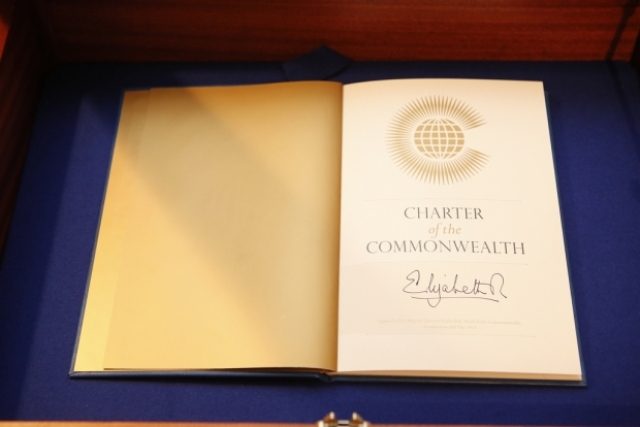
Both Malaysia and Singapore are members of the Commonwealth, an institution founded on respect for human rights, democracy and compassion within the rule of law (Commonwealth Secretariat, Citation2013). The Commonwealth Charter speaks of consensus, mutual respect and inclusiveness as foundations for peace and justice. These are not just words for ceremonial use; they are principles meant to guide how nations treat people at their most vulnerable. The tragedy of Jamaludin reminds us that compassion must not remain rhetorical. If the Charter is to retain meaning, its spirit must be visible in how states manage borders, migration, and human life itself. When regional systems fail to reflect empathy and equality, the Commonwealth’s own values stand exposed as ideals yet to be realised.
The Charter of the Commonwealth 2011-13: origins, text and potential
Student Debates: “This House thinks that Commonwealth commitments for human rights are just for public relations.”
Other examples from Commonwealth member states include Kenya which has adopted more progressive constitutional reforms and has placed human rights as the main reference, but implementation at the local level is still variable and is often influenced by the security perspective of migrants and refugees (Human Rights Watch, Citation2023). South Africa provides relatively stronger legal pathways for asylum seekers, but administrative delays and social tensions in some communities often constrain such protections from being fully operational (Human Rights Watch, Citation2023). The distance between legal ideas and everyday reality in these two countries shows how uneven the commitment to justice and human dignity is within the Commonwealth family (Asian-African Legal Consultative Organization, Citation2025).
When viewed together, these examples show that justice in Commonwealth countries is far from uniform. Attachment to the same legal tradition only gives the impression of unity on the surface, while migrant experience is determined by political choices, institutional capacity and social attitudes in each country (Asian-African Legal Consultative Organization, Citation2025). If the Commonwealth Charter is to remain meaningful, its value must be present in the way countries respond to human vulnerability at their borders.
Jamaludin’s story invites us to ask what kind of justice we practise in Southeast Asia. The Commonwealth often speaks of shared values, yet those values shrink when confronted with the lives of the poor and displaced. Migrant workers like Jamaludin inhabit the spaces between these ideals.
Reddy Anggara & Hendry Roris P. Sianturi are with the Departmentof Communication Studies, Universitas Singaperbangsa Karawang, Karawang, West Java, Indonesia.