[This is an excerpt from an article in The Round Table: The Commonwealth Journal of International Affairs and Policy Studies.]
There is no shortage of books on Idi Amin, an infamous historical figure, sometimes – inaccurately – likened to the Adolf Hitler of the African continent. There are myriad historical accounts that document and analyse various facets of Amin’s Uganda, from both Ugandan and non-Ugandan authors alike: examples include Henry Kyemba’s A State of Blood: The Inside Story of Idi Amin (1977); Alicia Decker’s In Idi Amin’s Shadow: Women, Gender, and Militarism in Uganda (2014); or Mark Leopold’s Idi Amin: The Story of Africa’s Icon of Evil (2020).
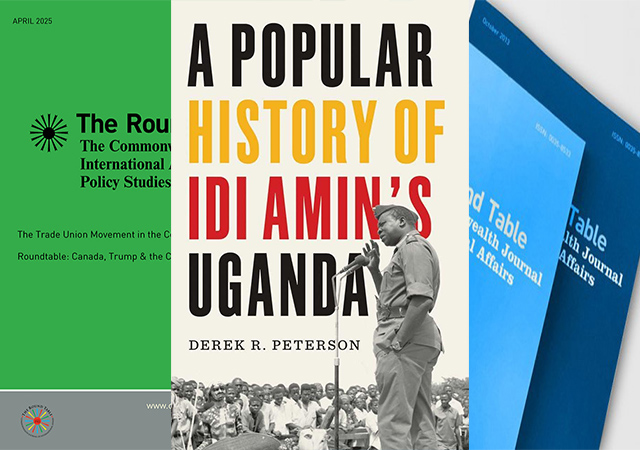
A Popular History of Idi Amin’s Uganda is the latest addition to the historiography. Written for a general audience, Peterson’s book examines how Amin’s brutal and authoritarian government was sustained and upheld through the quotidian actions of ‘thousands of ordinary people’ (p. 5). What made Amin’s regime so remarkable was the ways in which individuals in far-flung regions across Uganda – civil servants, clerks or radio engineers – felt a sense of mobilisation to participate on the frontlines in fighting against imperialism and racial inequalities. This, Peterson argues, was the main achievement of Amin’s regime: its ability to ‘transform the boring, technical work of government into a thrilling battle for racial and political liberation’ (p. 5). Peterson interrogates this very effectively through different lenses of public life under Idi Amin, including radio propaganda, bureaucracy, the Economic War, violence, religion and cultural life. It would be very easy to write a history of Uganda that centres on the capital city, Kampala; however, Peterson successfully counteracts the tendency towards urban bias in African historiography by drawing on a rich tapestry of examples from different regions in Uganda, providing both elite and non-elite Ugandan perspectives.
A particularly compelling aspect of A Popular History of Idi Amin’s Uganda is Peterson’s analysis of Amin’s Economic War. The arguably most famous facet to this is the expulsion of Uganda’s Asian community in 1972, which has attracted considerable coverage in both fictive and non-fictive accounts. Peterson diverts from this narrative, instead examining the ways in which the Economic War impacted non-elite Black Ugandans, ‘people without connections’, who frequently resorted to ‘financial strategies [that] ran afoul of government edicts’, such as smuggling or black-market commerce (p. 131). For these ‘crimes’, many of these individuals – including ‘petty traders’ and ‘market women’ – were tried by the Economic Crimes Tribunal (p. 131). The chapter’s persuasiveness lies in its critique of modern Uganda’s reckoning with the Amin years: while Museveni’s government focused from the 1990s onwards on compensating expelled Asians, Peterson argues that ‘there has been no justice for the thousands of Ugandans who were unwittingly caught up in the machinery of the Economic War’ (p. 136).
The ousting of IDI Amin
A notable absence in the book, however, is the perspectives and experiences of women. Apart from one example of a woman in southern Uganda rejecting the unwanted advances of a government chief, or a radio announcement that forbade women from wearing wigs, there are almost no specific examples that highlight the experiences of women under Idi Amin’s regime – this even though the gendered violence towards women in this period is well documented. The book is a missed opportunity in examining how women participated in the everydayness of sustaining Amin’s regime, and forming a fuller, more inclusive ‘popular history’.
Even more convincing than its argument is the methodology employed in A Popular History of Idi Amin’s Uganda. The book draws on 15 years of rich archival research conducted in different parts of Uganda, as well as around the world. Peterson cites Luganda-language documents and refers to oral history interviews he conducted within Uganda – with the help of translators – in different ethnic languages. Conducting qualitative research in Uganda is a challenging process, the success of which is based on positive relations cultivated between the researcher and various communities in the country. The detailed level of Peterson’s research is testimony to the years spent building sustainable relationships with Ugandan institutions, individuals and the historian community at large.
Amongst vivid descriptions of everyday life in Amin’s Uganda, Peterson details the process of conducting research in Uganda, which also involved restoring, digitising and cataloguing archival collections at remote institutions around the country. Particularly memorable incidents included fighting off insects from documents with cans of insecticide, or an intern discovering an undetonated explosive device in the archives of Kampala’s Central Police Station. These experiences highlight the near painstaking effort that is required to undertake research in an environment with limiting supportive infrastructure.
A Popular History of Idi Amin’s Uganda neither reveals new knowledge on the terror of this period in Uganda’s history, nor does it aim to ‘reconcile Ugandans with the traumas of the past’– both of which Peterson readily admits (p. 266). However, what makes the book so compelling is its illustration of the everydayness of a dictatorial regime.
Anna Adima, Department of History, Durham University, Durham, UK.
A popular history of Idi Amin’s Uganda by Derek Peterson, New Haven, CT, Yale University Press, 2025.