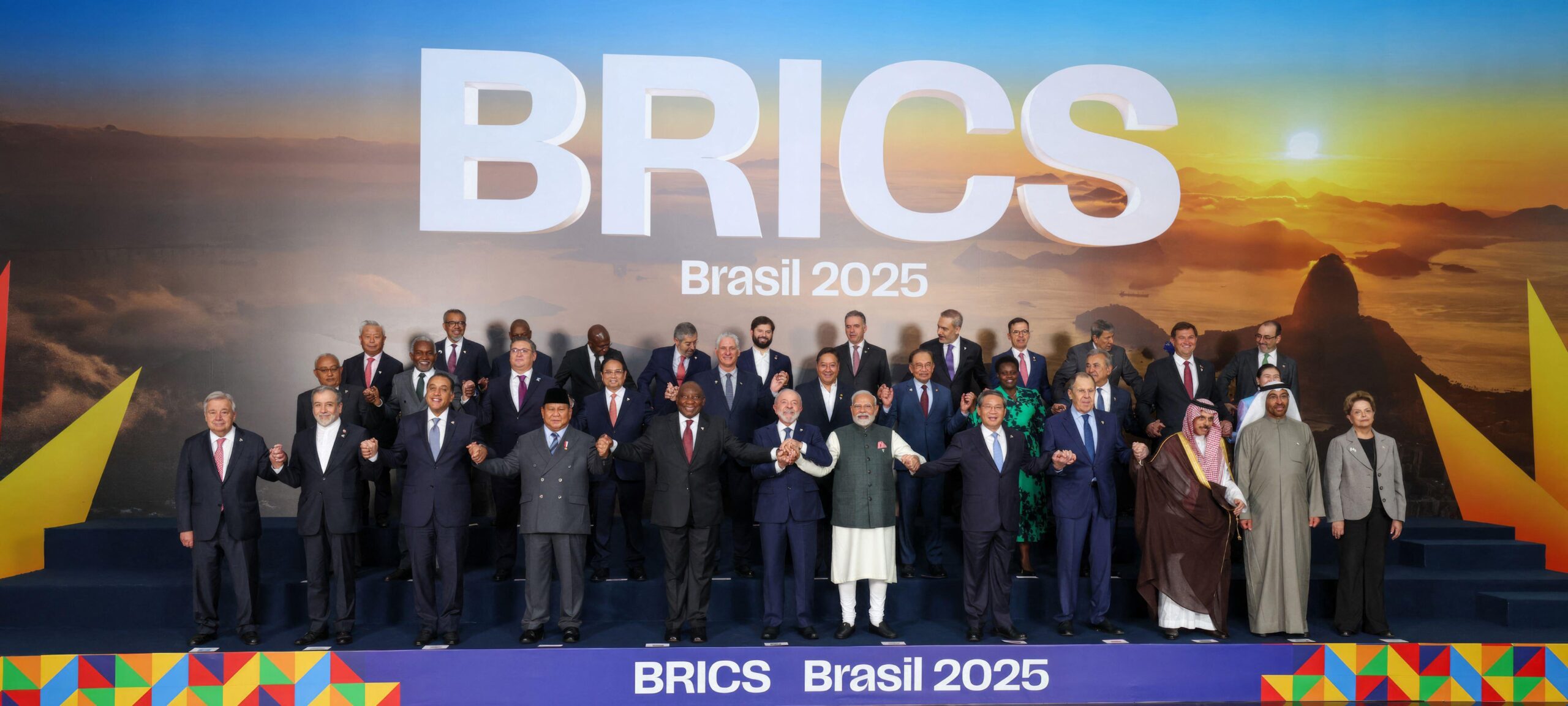
 July, 2025: Brazilian President Luiz Inacio Lula da Silva (centre) poses with the BRICS Plus, expanded leaders group BRICS Brazil Summit. [photo: Prime Ministers Office/Press Information Bureau/Alamy]
[This is an excerpt from an article in The Round Table: The Commonwealth Journal of International Affairs and Policy Studies. Opinions do not reflect the position of the editorial board.]
The road ahead: can BRICS build a durable multipolar architecture?
If BRICS [Brazil, Russia, India, China and South Africa] is to shape a multipolar world, it must evolve beyond symbolic declarations. Advancing concrete mechanisms, such as shared financial instruments, a functional BRICS currency or a supranational development fund for climate and AI, is essential (CFI, Citation2025; Savarese & Hughes, Citation2025). Institutional strength would also require consensus on trade, sanctions and security policy across diverse national interests.
Furthermore, maintaining unity within a heterogeneous bloc is challenging. India’s cautious stance, Brazil’s moderated diplomacy, and Russian and Chinese strategic opacity highlight competing interests and agenda between BRICS members. Shared priorities, such as climate finance, digital governance and Global South solidarity, must be actively pursued, with frameworks for reconciliation when individual interests diverge.
BRICS must balance assertiveness with engagement, in order to balance Western dominance. Summit attendees denounced protectionism but refrained from taking a confrontational stance with Russia, or on fossil fuel consumption. This indicates a pragmatic group strategy: critique as needed, but avoid ideological extremism to preserve both trade and political influence.
Leadership and continuity are vital for BRICS to enhance its geopolitical weight. Brazil’s 2025 presidency, followed by India in 2026, marks a regional leadership shift. India must build on Rio’s outcomes while balancing ties with China, Russia and the USA. Yet the ICC arrest warrant against Putin complicates Russia’s in-person participation, risking weaker symbolism if leaders are absent. China’s and Russia’s presence remains essential, and host nations must find pragmatic ways to keep Moscow engaged without undermining legitimacy.
BRICS expansion: implications for the Commonwealth
The expansion of BRICS signifies an important shift in global geopolitical and economic structures, presenting significant challenges and opportunities for the Commonwealth and its members. Recent additions such as Saudi Arabia and Argentina amplify BRICS’s influence, especially in discussions on global financial reform and the shift from dollar dependency (Encyclopedia Britannica, Citation2024; ING Think [ING], Citation2024).
For Commonwealth nations, especially prominent members such as India and South Africa, expanded BRICS membership provides alternative avenues for economic growth and strategic autonomy. India’s decision to prioritise BRICS (and the G20) highlights its aspirations to assert leadership among Global South countries, aiming for a multipolar international order less reliant on Western institutions (Carnegie Endowment, Citation2025; Democracy Now!, Citation2024). South Africa similarly leverages BRICS to diversify the country’s economic partnerships, consolidate regional leadership in Africa and reduce dependence on Western economic support (Carnegie Endowment, Citation2025). For both countries, the Commonwealth as an international organisation does not feature in their priorities among foreign policy platforms.
Restoring multilateralism: The challenge from the Global South and the rising minilaterals
15th BRICS summit: key takeaways and their relevance
The expanded BRICS also underlines the existing significant challenges for the Commonwealth as a cohesive international organisation. The prioritisation by key members of BRICS summits over attendance at Commonwealth meetings highlights continuing vulnerabilities in the Commonwealth’s perceived importance and struggle for relevance (Policy Exchange, Citation2024). Additionally, Commonwealth countries such as the United Kingdom, Canada and Australia must now navigate tensions between loyalty to traditional Commonwealth values, and the pragmatic economic and strategic necessity of engaging positively with an empowered BRICS alliance (European Parliament, Citation2024). Ultimately, BRICS’s expansion embodies a broader global transition towards multipolarity, placing the Commonwealth at a strategic crossroads. Commonwealth countries must carefully recalibrate their diplomatic and economic priorities to adapt effectively to this shifting international landscape.
Conclusion: a transformational moment or a hollow coalition?
The Rio summit was both ambitious and pragmatic, underscoring BRICS’s expanded global reach and diversified agenda. The bloc now faces a pivotal choice: it can harness its collective strength to advance a multilateral, multipolar order with stronger institutions, or risk allowing its efforts to dissipate into rhetoric without meaningful outcomes.
To succeed, BRICS must deepen its institutional frameworks, particularly in finance, trade and technology. Navigating geopolitical turbulence will require the preservation of unity by avoiding overtly anti-Western rhetoric, while instead highlighting pragmatic collaboration and cultivating partnerships that complement, rather than wholly reject, existing Western-anchored structures such as the Quad. Sustaining leadership credibility means not only reducing absenteeism at summits but also minimising public disagreements over divergent national interests and instead emphasising practical cooperation in areas of clear mutual benefit.
In sum, BRICS is neither a ready-made counterweight to the West nor yet a defunct experiment.
Apeksha Pandey is Assistant Professor, Amity Law School, Amity University, Madhya Pradesh.