
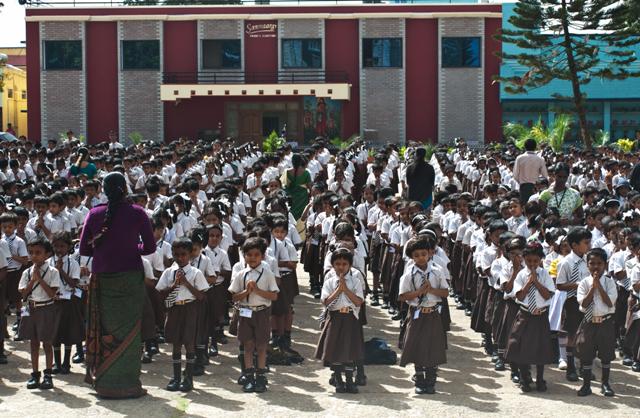
 Schoolchildren praying in a schoolyard in Mysore, Karnataka, India. [Photo: Franck Metois / Alamy Stock Photo]
[This is an excerpt from an article in The Round Table: The Commonwealth Journal of International Affairs and Policy Studies. Opinions expressed do not reflect the opinion of the editorial board.]
Although India has passed strict legislation to prevent female foeticide, implementation has been uneven and ineffective. The Pre-Conception and Pre-Natal Diagnostic Techniques (Prohibition of Sex Selection) Act, 1994 (PCPNDT Act) is the most significant piece of law. It forbids sex determination, regulates ultrasound facilities, and lays out penalties for anyone who violates it (Ministry of Health and Family Welfare, Citation1994). Following the Supreme Court’s ruling in CEHAT v. Union of India [CEHAT] (Citation2003), which ordered states to register ultrasonography clinics, confiscate unlawfully used equipment, and launch public awareness programmes, the Act was further reinforced. Additionally, gender equality is supported by the Constitutional framework. Article 21 safeguards the right to life and personal liberty, Article 15 forbids discrimination based on sex, and Article 14 ensures equality before the law (Ministry of Law and Justice, Citation1950). There are still sex-selective abortions performed despite these assurances. Cultural values frequently take precedence over legal rights, as demonstrated by this discrepancy between law and practice (Ranka, Citation2019). As a member of the Convention on the Elimination of All Forms of Discrimination Against Women (CEDAW), India is bound by the United Nations’ 1979 declaration that governments must eradicate discriminatory practices against women. Additionally, the 2013 Commonwealth Charter places a strong emphasis on women’s rights and gender equality, making female foeticide a breach of international agreements (UN Women [UN], Citation2020).
Raising awareness of the gravity of sex-selective abortion has been actively supported by the Indian judiciary. In 2003, the Court provided comprehensive guidelines for ultrasound clinic registration, the confiscation of unlicensed equipment, and the establishment of monitoring committees to ensure adherence to the PCPNDT Act (CEHAT, Citation2003). In a similar vein, the Court directed states to implement more stringent clinic surveillance and awareness campaigns to address the cultural preference for sons, characterising female foeticide as a ‘crime against humanity’ (Voluntary Health Association of Punjab v. Union of India, Citation2013). Although the gap between court decisions and their practical implementation is still noticeable, these instances show that the courts recognise female foeticide as a national concern.
Full article: Achieving the Promise to Leave No Girl behind in Commonwealth Countries
With an emphasis on raising awareness, educating girls and enforcing the PCPNDT Act more strictly, the government introduced the Beti Bachao, Beti Padhao programme in 2015 to address societal bias outside of the legal framework (Ministry of Women and Child Development, Citation2015). This programme was extended nationwide after being first introduced in 100 districts with the lowest child-to-sex ratios. However, according to a 2021 audit by the Comptroller and Auditor General of India (CAG), 78% of the funds were allocated to media publicity, with a smaller portion allocated to grassroots services such as monitoring systems, healthcare and education (Comptroller and Auditor General of India [CAG], Citation2021). This is one reason for the programme’s limited performance in increasing sex ratios, and like the PCPNDT Act, it underscores the persistent issue of good laws and programmes being poorly implemented. Reports indicate that ultrasound abuse persists, with numerous clinics performing abortions for financial gain and unlawfully disclosing the foetus’s sex. Female foeticide continues despite a strong legal framework because of cultural pressure on women, medical professionals’ collaboration and poor oversight (Patel & Parikh, Citation2025). Consequently, the PCPNDT Act is now a ‘toothless tiger’; it is powerful on paper but ineffective in practice.
More than just legislation is needed to combat female foeticide in India; cultural change and constant enforcement are also necessary (Ranka, Citation2019). A powerful legal foundation is already provided by the PCPNDT Act of 1994, but its poor execution has made it merely a symbolic measure (CEHAT, Citation2003). Stricter oversight of ultrasound clinics, frequent audits of medical records, and prompt, severe sanctions against physicians and clinics involved in sex determination are all necessary steps in the future (Variath, Citation2024). Loopholes will continue to be exploited unless medical accountability is enforced. However, laws cannot be successful on their own. It is imperative to confront patriarchal beliefs that favour sons over daughters. To change public opinion in both rural and urban areas, extensive social initiatives that go beyond phrases are required. Advertising campaigns must challenge the idea that only sons are valuable by highlighting the fact that daughters are also carriers of heritage, caring and financial security.
As women’s standing in families improves, the strain on boys lessens when girls have access to good education, stable employment and financial independence. To provide employment, scholarships and education at the local level, government initiatives such as Beti Bachao Beti Padhao must go beyond publicity (CAG, Citation2021; Ministry of Women and Child Development, Citation2015). Cooperation between religious organisations, educational institutions and local authorities is necessary to end son preference. As a fundamental human right, gender equality is emphasised in international agreements such as the Commonwealth Charter and CEDAW. In addition to being a health or demographic concern, female foeticide needs to be viewed as a human rights crisis (UNFPA India, Citation2023). Only then will India be able to progress towards a society that appreciates every child equally.
Neenu Anna Ninan is with the School of Legal Studies, Reva University, Bengaluru, India and Subin Thomas is with the Alliance School of Law, Alliance University, Bengaluru, India.