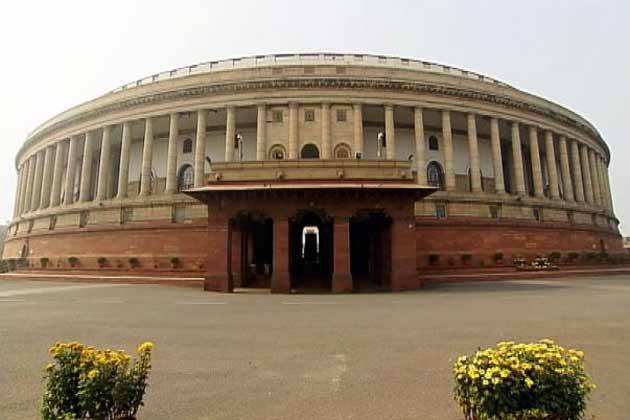
 Lok Sabha (lower house). [Photo of the Indian Parliament from Lok Sabha TV on Facebook]
[These two excerpts are from an article in The Round Table: The Commonwealth Journal of International Affairs and Policy Studies.]
India needs a fluid exchange between academic institutions, think tanks and government agencies to close this gap. Promoting structured fellowships, mid-career transitions and policy-oriented research collaborations could enhance the foreign policy framework. Until these changes take root, the divide between theory and practice will hinder strategic thinking and policymaking effectiveness in Indian IR. A frequent issue arises from applying modern political concepts to ancient texts. Terms such as ‘nation’, ‘population’ and ‘soft power’ are often inaccurately attributed to pre-modern India, resulting in misleading equivalences that obscure historical truths. The perception of the Arthashastra as a purely realist document reflects a narrow and selective interpretation. Although Kautilya’s pragmatic approach to power and strategy aligns with certain realist principles, simplifying his work to merely a ‘realpolitik’ perspective overlooks its broader philosophical foundations (Banerjee, Citation2012). The Arthashastra and the Dharmashastras recognise the ethical aspects of governance and the measured use of force. The artificial distinction that categorises the Arthashastra as secular and pragmatic while viewing the Dharmashastras as idealistic and moralistic ignores their shared intellectual heritage. Instead of examining these texts with nuance, many scholars impose Western theoretical frameworks onto Indian traditions, resulting in superficial comparisons rather than meaningful intellectual discourse (Datta-Ray, Citation2015, p. 111; Gautam et al., Citation2015–2016).
International relations in India: moving past the Western paradigm
International Relations (IR) in India encompasses more than just establishing an ‘Indian school of IR’; it aspires to redefine the entire field. The prevailing question, ‘Why is there no non-Western IR theory in India?’ is fundamentally misguided. It suggests a binary perspective that views the West as the leading creator of knowledge, while the non-West consumes it. This binary is not just a description but a form of hierarchy, sustaining a global intellectual system where Western theories dominate the discourse, often relegating non-Western perspectives to a lesser, derivative position. Consequently, even if Indian scholars successfully formed an ‘Indian school of IR’, it would likely remain a marginal subfield within the more significant Western-led discipline. At most, it would provide only a minor contribution to the overarching narrative of IR, failing to reshape its theoretical bases fundamentally. Thus, the key challenge lies not in crafting a separate non-Western IR theory in India but rather in advancing towards a post-Western IR that transcends Western-centric epistemologies, embracing diverse intellectual traditions as equal partners in global discourse. This shift necessitates that Indian scholars engage critically with indigenous traditions and global theories, unbound by the constraints of Western IR frameworks. Instead of relegating Indian thought as an alternative to Western paradigms, a post-Western IR approach aims to decentralise knowledge production, fostering multiple, context-rich understandings of international politics. Such a transformation requires a reassessment of classical Indian strategic thought and a broader initiative to rethink IR’s conceptual underpinnings, moving beyond the simple divide between ‘Western’ and ‘non-Western’ scholarship.
New world order in the Indo-Pacific: Challenges and prospects for India
India in a changing global world: understanding India’s changing statecraft and Delhi’s international relations
Excerpt two:
The growing attempt to integrate the intellectual heritage of India into International Relations (IR) scholarship is a sign of growing confidence in recovering indigenous lenses. However, the effectiveness of this enterprise depends on scholars’ ability to traverse successfully and decode India’s rich written and oral traditions with both empirical and theoretical rigour (Kaviraj, Citation1991). Substantive engagement requires more than tokenistic references; instead, serious engagement requires deep historical study, familiarity with languages, and critical scrutiny to make India’s intellectual traditions speak to contemporary problems rather than essaying them romantically. A critical influence on this process is the political resurgence of Hindu nationalism, which has increasingly defined debate about India’s identity, past and role in the world (Hall, Citation2023). Historically, fear of association with nationalist or right-leaning forces has held back some scholars from taking pre-modern Indian strategic thought seriously. This debate is almost organically linked with populism, which commonly attempts to recover a lost heritage by framing historical narratives to shape contemporary politics. Hindu nationalist populism emphasises civilisational continuity for India, framing the country as a great power with deep traditions in governance, strategy and diplomacy. While this has generated wider public interest in works like the Arthashastra, it also raises concerns about interpretations that selectively co-opt historical narratives with political agendas rather than upholding scholarly standards. So, the challenge before Indian IR scholars is to navigate this complex landscape, embracing indigenous lenses while keeping a critical remove that precludes ideological capture. The aim must be to recover and re-interpret India’s traditions to deepen world-wide IR theory and practice, and not simply merely reinforce nationalist narrative.
Conclusion
Examining India’s role in International Relations (IR) involves reassessing the core knowledge that shapes the field, questioning prevailing Western-centric frameworks and facilitating diverse intellectual traditions. This endeavour goes beyond merely adding non-Western views to current models; it requires establishing new knowledge production sites utilising alternative theories, methodologies and concepts.
Sreshtha Chakraborty is Assistant Professor, School of Law, Bennett University, Delhi-NCR, India.