[This is an excerpt from an article in The Round Table: The Commonwealth Journal of International Affairs and Policy Studies.]
The book is insightful on the geopolitics affecting Greenland (especially Chapter 6), duly noting the impact of climate change and mining developments. On the latter, one US concern is the increasing involvement of China in mineral exploration, noting also that China has become closer to Iceland through such means as the free trade agreement of 2013. The maps in the book are helpful but having at least one map covering a slightly broader area would show that north eastern China is not a long way from Greenland. Australia is actually a significant presence in mineral exploration in Greenland (through the Perth-based Energy Transition Minerals, involved in a project to develop rare earths, zinc and uranium in southwest Greenland), but clearly not significant geopolitically.
Among Commonwealth countries relevant to Greenland, more might have been made of Canada. There is mention of the famous dispute between Denmark and Canada over Hans Island, but Trump’s plans for Greenland if ever implemented would have a significant impact on Canada, leading to a virtual US encirclement. Greenland is closer to Canada than it is to the US, whether one is referring to the northeastern US or Alaska. But then Trump also wants to acquire Canada.
The book captures the dynamics of the relationship between Denmark and Greenland within the Kingdom of Denmark (also involving the Faeroes). Essentially this is an issue of what is entailed in autonomy, with Greenland expanding its scope for independent action but remaining within the Kingdom of Denmark. While most Greenlanders aspire to independence the question is what would become of the massive financial support provided by Denmark. More analysis of how this aspiration plays out in Greenlandic politics would be helpful. Greenland, along with Denmark itself, has a social democratic culture, including a welfare state. While Buchanan refers to the compacts of free association the US has with the Federated States of Micronesia, the Marshall Islands and Palau as possible models for continuing budgetary support to small independent states, one should keep in mind that the centre of political gravity in the US is a long way to the right of what prevails in Denmark and Greenland.
Book reviews from the Round Table Journal
More about the Round Table Journal
Commonwealth models that might be relevant to the future of the Greenland-Denmark relationship include Australia’s ongoing financial support for Papua New Guinea since independence in 1975 (at first direct budgetary support, and later support in the context of development assistance), as well as for many other Pacific island countries (Commonwealth members), not to mention New Zealand’s relationship with Cook Islands and Niue, and the various ways in which Britain supports its former colonial territories, especially the smaller and more vulnerable countries in the developing world. Greenland (current population of almost 58,000) would meet the criteria for becoming a Commonwealth small state should it ever become independent and aspire to join the organisation.
The reference to Australia’s constitutional status (p. 40) was confused and not all that helpful in a book about Greenland. As the author writes, Australia (presumably meaning New South Wales) was a British colony in 1788, but this was within the context of a British constitutional monarchy 18th century style (George III, despite the US patriotic narrative, was not a ‘tyrant’). In 1901 the Commonwealth of Australia came under the British constitutional monarch (Queen Victoria at the very beginning), with a form of home rule (not fully independent, but self-governing); independence came after the Statute of Westminster in 1931, but not immediately (and some would say not until the legalities were tidied up in the Australia Act of 1986). To say that ‘The monarchy of the United Kingdom can dissolve (and has dissolved) the Australian government’ (p. 40) is a misreading of the dismissal of the Whitlam Labor government by Governor-General Sir John Kerr on 11 November 1975. Kerr was in fact nominated by Whitlam and consulted advisers to the Queen (notably Sir Martin Charteris, the Queen’s private secretary) to reassure himself about what he proposed, but it was Kerr alone who acted.
If insights from Australia were relevant, one area to investigate would be indigenous affairs, keeping in mind that the Australian aborigines have a history going back 65,000 years compared with about six hundred years for the Inuit of Greenland (allowing for some related peoples having been in Greenland and then moving on before the arrival of the Norse settlers in the 9th century). Canada, with its own Inuit, would be very relevant, keeping in mind the experiences with indigenous autonomy such as the Canadian territory of Nunavut, the Nunatsiavut Government (province of Newfoundland and Labrador) and the Kativik Regional Government covering most of the Inuit region of Nunavik (northern Quebec).
In discussing various possible scenarios at the end of the book, the author is probably right in arguing that the status quo or some variation on the status quo is the likely future. The conundrum for a move towards independence is whether such a move is compatible with continued financial support from Denmark. More mining and increased shipping because of climate change might bring in more revenue, suggesting another conundrum if Greenland were to benefit in this way.
In terms of negotiating its political future with Denmark, US interest might give Greenland more leverage. But how would the US advance its plan to acquire Greenland? What would be the process internationally and within the US political and constitutional framework? The author points out various obstacles relating to Denmark (including Greenland in most respects) being a member of both the North Atlantic Treaty Organization and the European Union.
Derek McDougall is with the School of Social and Political Sciences, University of Melbourne.
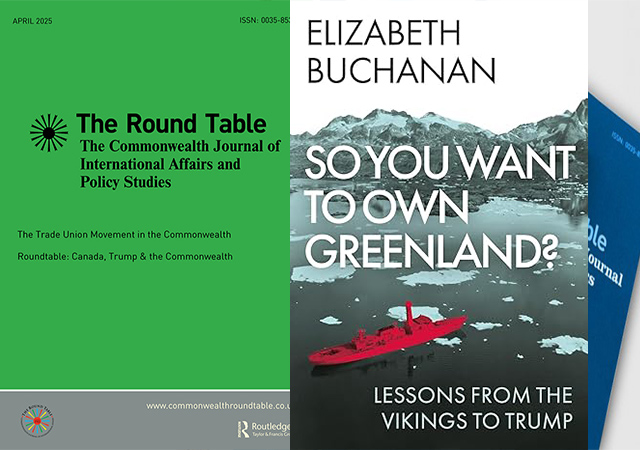
So you want to own Greenland? Lessons from the Vikings to Trump by Elizabeth Buchanan, London, Hurst, 2025.