
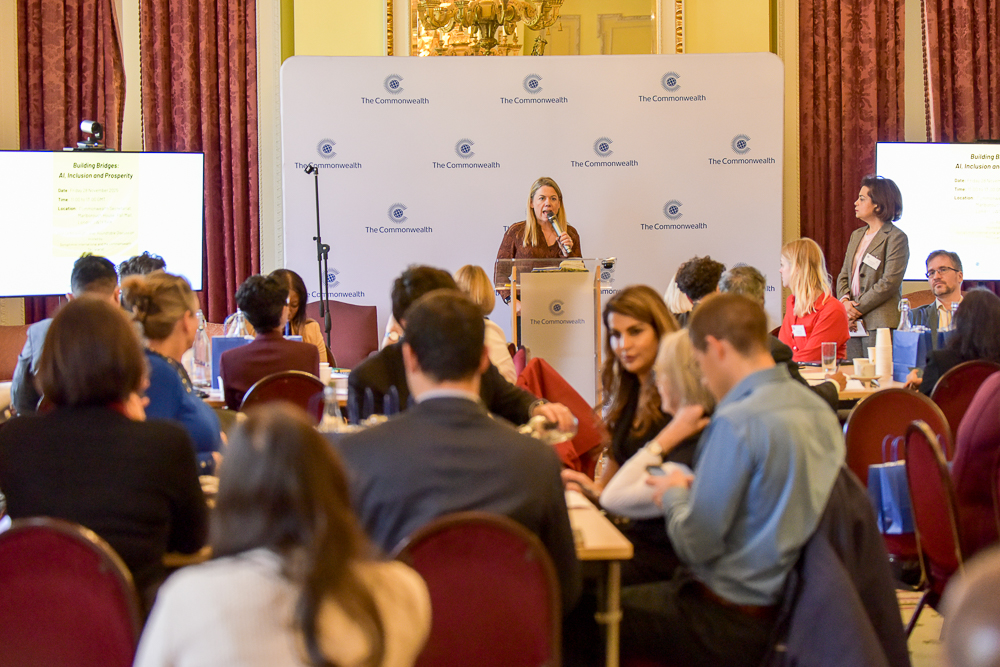
 Photo: (c)Ken Peachey, courtesy of the Commonwealth Secretariat.
Ensuring that artificial intelligence does not accentuate inequality in the Commonwealth – does not leave anyone behind – was the subject of a roundtable at Commonwealth headquarters at the end of November titled “Shaping an Equitable Future with AI”.
The 28 November roundtable was organised by Soroptomist International, a longstanding women’s organisation accredited with the Commonwealth, in conjunction with the Commonwealth Secretariat. Overall, women’s inclusion and prosperity was the main opportunity of AI outlined in the background documents, but the threats to inclusivity and equality were inescapable.
“Artificial intelligence must be shaped so that it narrows, rather than widens, the gaps that all women and girls already face in education, work and access to technology,” said Soroptimist International President (2024–2025), Siew Yong Gnanalingam.
Other speakers at the event stressed that while AI could be used to promote women’s businesses and financial inclusion, it can also increase economic inequality by excluding poorer women and concentrating power and wealth in the hands of those who control the development and deployment of artificial intelligence.
Ensuring that AI doesn’t undermine inclusivity is going to be a key element of the economic resilience that is one of the three Commonwealth strategic objectives set out in the new Commonwealth Secretariat strategic plan. But AI also has implications for the other two objectives – democratic and environmental resilience.
Unexplored tool for sustainable development: Can artificial intelligence promote good health and well-being in Africa?
Democracy is one of the key values of the Commonwealth (and is, of course, key to regulating AI in the interests of ordinary people), but the impact of AI on democracy is demonstrated by the use of deepfakes, the captured algorithms of social media and targeted interventions in elections.
Meanwhile the data processing centres required for widespread AI threaten already shrinking water supplies and monopolised access to the critical minerals needed for AI-driven tech threatens the environment and the stability of developing countries, especially in Africa.
Experts in the field led smaller roundtables composed of civil society representatives, academics and women’s advocates on issues such as skills development, the future of work, financial inclusion, gender, youth and governance, which addresses these challenges.
Opening the event online from the Association of Commonwealth Universities conference in Nairobi, Commonwealth Deputy Secretary General Arjoon Sidhoo said that AI was on the lips of every Vice Chancellor he had met.
That set the tone for conclusions dominated by the importance of education, and the way in which a liberal, critical education is vital to ensuring AI does not further distort the world. Critical skills were frequently mentioned as vital to ensuring AI does not promote further inequality, does not drive people out of some jobs altogether and does not undermine the democratic values which are at the heart of the Commonwealth.
Renata Trottman Probst, President Elect of the Soroptimists, concluded the roundtable by stressing how AI challenged “ethics, co-operation and human rights”. Recognising that women and girls faced potentially great disadvantage, she said that they needed to be “empowered as meaningful actors” if that threat was to be avoided.
Will the Commonwealth be the vehicle to lead that challenge?
Owen Tudor is a member of the Round Table editorial board.