[This is an excerpt from an article in The Round Table: The Commonwealth Journal of International Affairs and Policy Studies.]
The partitions began in 1937 when Burma was separated from India as a crown colony to meet anti-Hindu-India nationalist demands and enable London to establish direct links separate from Delhi. Also that year, the separation of Aden began the Arabian Peninsula partitions that continued till the Persian Gulf states were split off in 1947.
India’s political leaders did not oppose losing the (Muslim) Gulf states, and Dalrymple describes this as ‘India’s greatest lost opportunity’ because of the oil wealth that was discovered later. But for these partitions, he says, the countries ‘might have become part of India or Pakistan after independence’. That, however, is surely a most improbable ‘what if … ’, not least because of the unreality of expecting those Muslim nations to accept life run from Hindu India.
The blood-filled creation of Pakistan in 1947 came next, which Dalrymple presents as an idea that flowed from the partitions of Burma and Aden. After years of discussions Jawaharlal Nehru, who was about to become independent India’s first prime minister, admitted ‘we are tired men’ and said the plan for partition ‘offered a way out and we took it’. Dalrymple, however, does not adequately blame Nehru for killing off an earlier ‘way out’. In a July 1946 speech, he had refused to honour what was known as the widely accepted ‘Cabinet Mission’ plan for a federal set-up, which would have avoided the violent partition and all that followed.
Next came the fourth partition, when the new Indian government headed by Nehru and his tough Home Minister, Sardar Patel, virtually instructed India’s 562 princely states to cede to Delhi.
As the empire gradually ‘shattered’, some colonies became republics, cutting all links with Britain, while others settled for dominion status and became part of the Commonwealth, which later also admitted republican India and others. Dalrymple sadly does not deal with this aspect of international affairs. That may be because he focuses on the gradual decline of empire, rather than tracking later institutions, though the idea of the Commonwealth goes back to the 1880s.
India-Pakistan tensions
Book Review – Another India: The making of the world’s largest minority 1947–77
Within the Indian subcontinent, the colonies of Pakistan (with Bangladesh hived off in 1971 as Dalrymple’s fifth partition) and Ceylon (Sri Lanka) did join the Commonwealth, but Nepal and Bhutan did not because they prized their independence. Neither did Burma. The Gulf states were technically eligible but chose the regional Gulf Co-operation Council that was set up in 1981. This was in line with earlier opt-outs by Palestine and others in the region, though Palestine and Yemen did apply for membership in 1997 without any decision being made. (Palestine’s case and the role of the Commonwealth is now being informally discussed at a time when international support for its statehood is growing).
Significantly, Dalrymple shows how the current Indian government’s Hindutva focus has roots in those years when the British tacitly agreed that ‘India belonged primarily to the Hindus’ and hived off the largely non-Hindu parts. Hindu nationalism ‘was a key driving force in those earlier partitions’ of Burma and Aden, as well as the later division of India and Pakistan.
This is a magnificent (and massive) first book by Sam Dalrymple. It misses out or underplays various turning points in history, and could have usefully included the evolution of the Commonwealth. But it does add a new perspective to the region’s history, and the accidents of history, covering a wide canvas with an appealing writing style that makes for compelling reading.
John Elliott is a foreign correspondent, formerly in India, for the Financial Times, and The Economist. He is also a member of the Round Table editorial board.
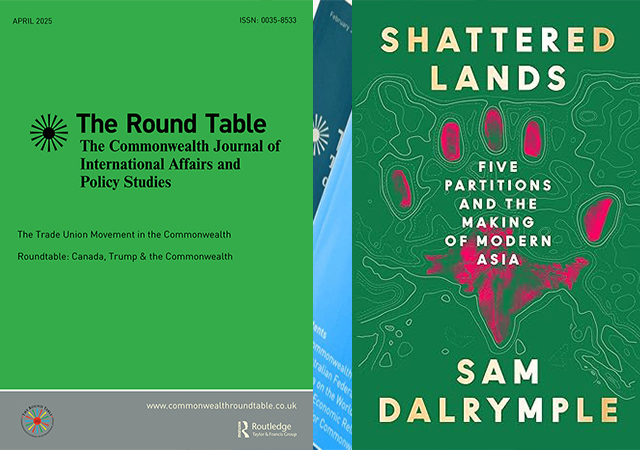
Shattered lands: Five partitions and the making of modern Asia by Sam Dalrymple, London, William Collins, 2025.