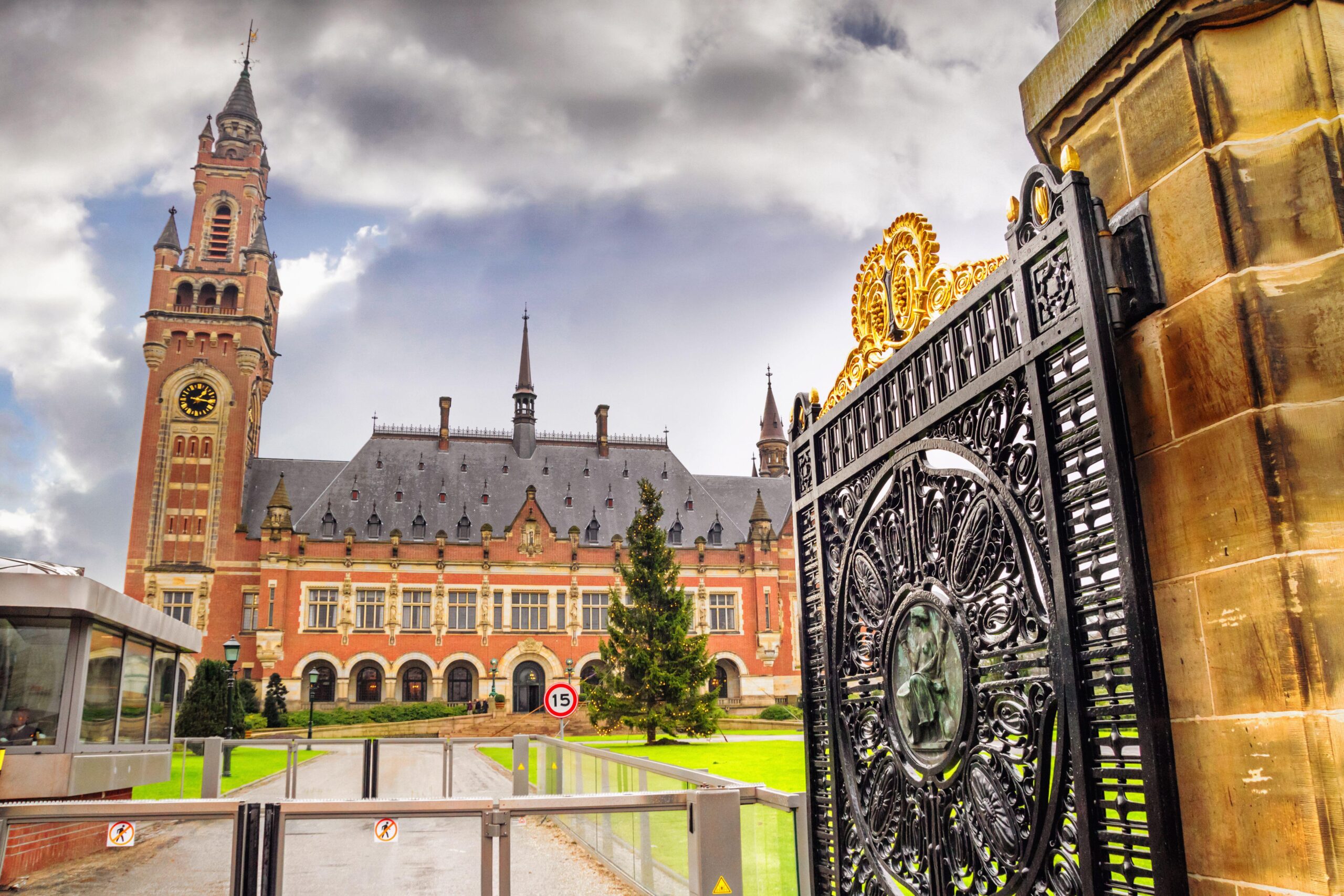
 The administrative building the International Court of Justice in The Hague.
[photo: Rustamank/ Alamy]
The administrative building the International Court of Justice in The Hague.
[photo: Rustamank/ Alamy]
[This is an article in The Round Table: The Commonwealth Journal of International Affairs and Policy Studies. Opinions expressed do not reflect the position of the Round Table editorial board.]
In a not implausible scenario, if the International Court of Justice rules against him, President Nicolás Maduro of Venezuela could invade Guyana in the near future. Venezuela not only claims the Essequibo, a large oil-rich section of its neighbour, but has been carrying out bogus ‘elections’ for it. If so, what will the Commonwealth do?
The Commonwealth has no defence treaty, nothing like Article 5 in the North Atlantic Treaty Organisation (NATO) which requires all members to come to the aid of any which is attacked – a reason why its allies came to the aid of the United States in Afghanistan, after New York was the target of Al-Qaeda in 9/11. By contrast, the rationale of the modern Commonwealth is pacific, leaving the hard and dangerous work of peacekeeping to the United Nations, for which many Commonwealth members have contributed troops.
Indeed, Commonwealth countries are playing their part in keeping large swathes of the globe free from nuclear warfare. The 13 signatories of the Treaty of Raratonga, which commits them to a nuclear-free zone in the South Pacific, and which came into effect in 1986, are all Commonwealth states. Nearly 20 years earlier the Treaty of Tlatelolco, to which 12 Caribbean Commonwealth states now belong, affirmed the same ambition for Latin America and the Caribbean. More recently, supported by the African Union as well as the UN, the comparable Treaty of Pelindaba came into effect in 2009 for Africa; 19 Commonwealth states signed up.
But this preventive approach may not help in a crisis. Should Venezuela invade Guyana, what might happen? The Organisation of American States (OAS), currently chaired by the veteran diplomat Sir Ronald Sanders of Antigua and Barbuda, would denounce the attack on the sovereignty of a member; he was recently given an award by Ukraine after the OAS spoke up for that invaded country; and over 40 years ago, when Argentina invaded the Falklands, Caribbean members of the OAS baulked OAS support for the aggressor. The Commonwealth would expostulate and seek to activate the UN. CARICOM, where some states depend on cheap Venezuelan oil, would not risk its small militaries in a war.
Recently the United Kingdom, from which Guyana gained independence in 1966, sent a warship to its waters as support for its maritime oil rights and, in a Trumpian gesture, three US warships have lately arrived off the shores of Venezuela. The US deployment, explained as an attempt to thwart a narcotics cartel, but also a warning to Maduro, may be more performative than genuinely threatening. President Trump’s attempt to overthrow Maduro in 2019 was a failure. In reality, it is only Brazil, which has moved troops to its Venezuelan border before now, that might protect its small but increasingly wealthy neighbour.
Guyana, its foreign policy, and its path to development
The question therefore arises, what use is the Commonwealth in the brutal 21st century world of hard power, and realpolitik? It is no secret that the 56 members are divided in their allegiances. Pakistan and India have never been the best of friends, while India continues to import Russian oil and weapons, and is embroiled in a trade war with the US. The UK clings to its uncertain status as a ‘special relation’ of the US, not dissimilar from Australia. Meanwhile, in Africa, members such as Uganda and Rwanda pursue different national interests in the endless struggles over minerals and territory in eastern Democratic Republic of Congo.
When President Trump made his threats to annexe Canada, many who have the Commonwealth at heart were saddened that there was no spirited response from the Commonwealth Secretary-General. It was left to King Charles, ceremonial constitutional head of the Canadian state, to take public steps of firm rebuttal – in welcoming Prime Minister Mark Carney to his home in the UK and reading his government’s speech from the throne in the Ottawa Parliament. Much of the Canadian history, going back to the loyalists who trekked north after the US came into being in 1776, and to the French Canadians who preferred a British monarchy to a revolutionary republic, is predicated on not being like their southern neighbours.
So is membership of the Commonwealth just a fuzzy feeling, like the kind of friendship you rarely consider, and which doesn’t mean very much? Like belonging to a family that forgot any mutual obligations? Is there any backbone to it? It was understandable that, during the Cold War, Secretaries-General Arnold Smith and ‘Sonny’ Ramphal decided to head the association off in non-military directions important to citizens – combating racism, arguing for development, education and the environment. No Commonwealth government or citizen would quarrel with these, and Chief Emeka Anyaoku and successors have pushed democracy and rights as well.
The over-arching challenge for Secretary-General Botchwey is to make the Commonwealth consequential again. Since it has abjured the use of violence as an entity itself, it must utilise diplomatic skills to ward off any threats to a member. And must be seen to do so.
Richard Bourne is an Emeritus Member of the Round Table Editorial Board.