
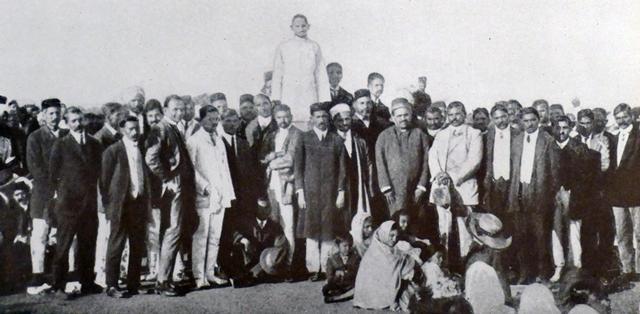
 Mohandas Karamchand Gandhi addressing an Indian community audience in South Africa, 1910. Gandhi established a community called 'Tolstoy Farm' near Johannesburg, where he nurtured his policy of peaceful resistance. [photo: World History Archive/ Alamy]
[This is an excerpt from an article in The Round Table: The Commonwealth Journal of International Affairs and Policy Studies. Opinions expressed do not reflect the position of the Round Table editorial board.]
Mahatma Gandhi’s life offers a paradoxical narrative of inconsistencies which ultimately helped him develop into a strong leader. A critical analysis of Gandhi’s experiences during his early years in South Africa until his return to India, reveals a complex path full of apparent contradictions. More importantly, Gandhi’s involvement and support for the British in the 1906 Bambatha Rebellion in South Africa and World War I appears to be at odds with his later stance as a champion of anti-British and anti-colonial attitudes. These inconsistencies have prompted considerable debate amongst academics: some scholars believe these inconsistencies reflect Gandhi’s continuous process of self-discovery, while others regard these anomalies as a sign of his practical approach to politics. However, it is precisely this paradoxical nature of Gandhi’s life that ultimately contributed to his growth into an influential leader.
This commentary points to one such instance of Gandhi’s inconsistencies in the 1906 Bambatha Rebellion against the new British poll tax system in Natal. The Bambatha Rebellion, also known as the Zulu Rebellion, is an important event in the history of South Africa. It was led by Bambatha kaMancinza, a leader from the Zondi clan of the Zulu community who lived in the Mpanza Valley of Natal (now KwaZulu-Natal) province. The tax was imposed by the British as part of a larger campaign to tighten control over the economic activities of Black Africans. The tax prompted widespread discontent, particularly amongst Zulus who felt that the levy was an unfair burden. Thus, the Bambatha Rebellion led to guerrilla warfare against the British imperial forces who responded with brutal repression of Zulus; thousands of people were killed, including Bambatha himself.
At that time Gandhi was living in South Africa, where he had already established himself as the leader of the Indian community. Gandhi’s involvement in the Bambatha Rebellion was both significant as well as controversial. This is because he did not support the Zulu Rebellion; rather, he supported the British colonial authorities. Gandhi had previously also backed the British during the Anglo-South African War (Boer War) from 1899 to 1902. On both occasions, Gandhi established an Indian Ambulance Corps to aid injured British soldiers. Gandhi thought that by displaying allegiance to British colonial rule, Indians could gain better treatment and recognition of their political and economic rights. ‘I felt that if I demanded rights as a British citizen, it was also my duty as such to participate in the defence of the British Empire’.Footnote1 In their book, The South African Gandhi: Stretcher-Bearer of Empire, published in 2015, historians Ashwin Desai and Goolam Vahed provide a detailed critique of Gandhi’s actions and views.
In this context, it is worth mentioning Gandhi’s wider engagement in South Africa. From the start, Gandhi’s goals were to advance Indian civil rights and to combat prejudice against Indians. He established the Natal Indian Congress in 1894 with the goal of bringing Indians together in their struggle for their rights. In order to spread awareness, he started the periodical Indian Opinion and founded the Phoenix Settlement for communal life. Gandhi created Satyagraha, a non-violent opposition ideology, in response to colonial racial discriminatory laws. Gandhi was concerned about wider racial inequality, but his main concentration was on winning rights for the Indian minority. However, after observing the disparities and injustices faced by Black Africans in South Africa, Gandhi strongly supported the formation of the African National Congress in 1912. However, the Indian cause remained the main focus of his advocacy, and his early writings occasionally mirrored the racial sentiments of the day. With time, Gandhi’s viewpoint changed, and he started to support more inclusive justice. However, his efforts to combat more general racial prejudice paled in comparison to his concentrated efforts to defend Indian rights. Gandhi still considered Black Africans to be the ‘sons of the soil’ and he did not want any association between native Africans and the Indian community. Thus, it became evident that Gandhi was fighting for the cause of Indians rather than the combined cause of rights for the Africans and Indians. He was concerned that if Indian South Africans took any steps to support the cause of Black Africans, it would stir up fear amongst the English and Afrikaner communities, stimulating hostility towards Indians, which he did not want. In his writings in this period, Gandhi was careful not to give an account of his interactions with African leaders.
Gandhi’s perspective on European colonialism was said to have changed significantly after the 1906 Bambatha Rebellion. His growing disenchantment with British rule was exacerbated by the violent suppression of Zulus, and the Indians’ inability to make substantial gains despite their backing for the British war effort in World War I. Gandhi began to seriously doubt the morality of British colonisation, and to rethink his political philosophy. As a result of this, after returning to India in 1915, he became dedicated in his resolve to use Satyagraha, originally developed during his struggles against racial injustice in South Africa. Satyagraha, which means ‘truth-force’ or ‘soul-force’, was based on the principles of non-violence (ahimsa), truth (satya), civil disobedience and non-cooperation.
After reaching India in 1915, Gandhi refrained from immediately starting a campaign of political agitation; instead, he travelled around the country in order to understand the plight of Indians better. After finishing this journey, he started the Non-Cooperation Movement, which called for Indians to stop supporting the British government in an effort to paralyse it. So as to organise the population against colonial control, Gandhi went on to step up this strategy with the Civil Disobedience Movement, which involved the wilful and non-violent breaking of unfair laws.
Anurag Tripathi & Pournamy are Associate Professors, Christ University.